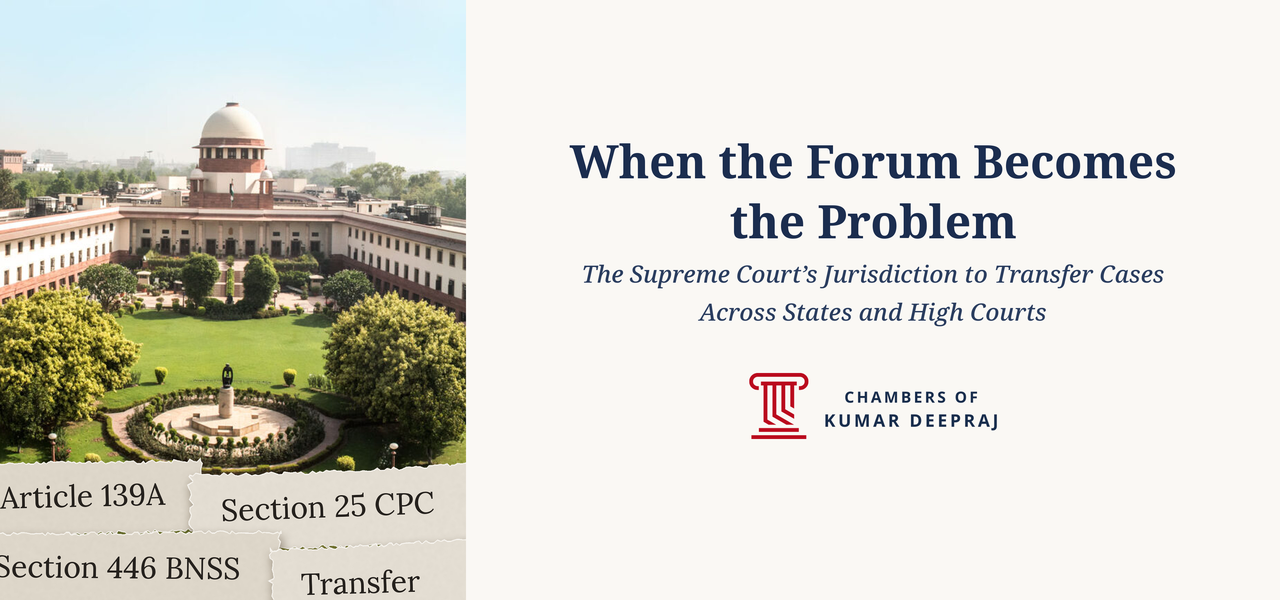
A practitioner’s guide to when, how and on what grounds the Supreme Court of India will move a civil, matrimonial, criminal or constitutional case from one State or High Court to another, read with the Bharatiya Nagarik Suraksha Sanhita, 2023 and the Court’s decisions up to November 2026.
Introduction: When the Place of Trial Decides the Outcome
Litigation in India is rarely confined to one city. A husband files for divorce in Pune while his wife lives with their child in Patna; a bank files a cheque-dishonour complaint in Chandigarh against a borrower whose business, books and witnesses are in Coimbatore; a television anchor faces FIRs in several States over a single broadcast; the same statute is challenged in three High Courts at once. In each of these situations the question of where the case is heard can matter as much as what the law says, because a forum that is distant, hostile or duplicated can turn a right of defence into a test of endurance. The Constitution and the procedural codes therefore give the Supreme Court a power that no other court in the country holds in full: the power to take a case pending in one State and place it in another, or to withdraw cases pending in several High Courts and decide the common question itself.
This jurisdiction is exercised every working day. Transfer petitions appear in large numbers on the Court’s miscellaneous cause lists, most of them matrimonial, and the civil transfer petitions filed in 2026 had been numbered past 3,000 by the second week of October.[1] For a litigant facing proceedings in a distant forum, a well-drafted transfer petition is often the first point at which a stay, a mediation referral or a realistic settlement becomes possible. Yet the power is discretionary, it is spread across several different provisions, and it is bounded by limits that the Court has repeatedly enforced. This article sets out where the power comes from, how the Court has read each source of it, the recent decisions that shape current practice, including the January 2026 judgment in Neha Lal v. Abhishek Kumar and the pending larger-bench reference on whether inconvenience alone can justify the transfer of a criminal case, and the procedure by which a transfer petition is brought and opposed.
The Sources of the Power: A Constitutional Provision, Two Procedural Codes and a Residuary Reserve
The Supreme Court’s transfer jurisdiction rests on four foundations. The first is Article 139A of the Constitution, inserted by the Constitution (Forty-second Amendment) Act, 1976 with effect from 1 February 1977, whose first clause was recast by the Constitution (Forty-fourth Amendment) Act, 1978 with effect from 1 August 1979.[2] It deals with cases pending in High Courts: clause (1) allows the Supreme Court to withdraw to itself cases raising the same or substantially the same questions of law, and clause (2) allows it to move any case, appeal or other proceeding from one High Court to another. The second is Section 25 of the Code of Civil Procedure, 1908, substituted in its present form by the Code of Civil Procedure (Amendment) Act, 1976, which empowers the Court to transfer any suit, appeal or other proceeding from a High Court or other civil court in one State to a High Court or other civil court in another State.[3] Before that amendment, the power under Section 25 rested with the State Government rather than with the Court. The third is Section 446 of the Bharatiya Nagarik Suraksha Sanhita, 2023 (BNSS), which re-enacts Section 406 of the Code of Criminal Procedure, 1973 and allows the Court to transfer any particular criminal case or appeal from one High Court to another, or from a criminal court subordinate to one High Court to a criminal court of equal or superior jurisdiction subordinate to another.[4]
The fourth foundation is the Court’s own constitutional reserve under Articles 32, 136 and 142. In Union Carbide Corporation v. Union of India the Court held that Article 139A does not exhaust its power to withdraw and transfer proceedings, and that it was never intended to whittle down the wide powers available under Articles 136 and 142.[5] A Constitution Bench carried the point further in Anita Kushwaha v. Pushap Sudan (2016). At that time neither Section 25 of the Code of Civil Procedure nor Section 406 of the Code of Criminal Procedure extended to Jammu and Kashmir, and Article 139A did not apply there either. The Court nonetheless held that access to justice is a facet of the right to life under Article 21, and that where refusing a transfer into or out of that State would deny a litigant that access, the Court could direct the transfer in exercise of its powers under Articles 32 and 142.[6] The statutory provisions, in other words, describe the ordinary channels through which the power flows, not its outer boundary.
Equally important is what the Supreme Court will not ordinarily do. Transfers between courts within a single State are the business of the High Court under Section 24 of the Code of Civil Procedure and Section 447 of the BNSS, and the Supreme Court is approached only where the two courts lie in different States.[7] Even this line carries a nuance. In Shah Newaz Khan v. State of Nagaland (2023), litigants who had filed a suit at Dimapur in Nagaland sought its transfer to Guwahati in Assam, citing hostile circumstances. The Gauhati High Court declined, reasoning that only the Supreme Court could order an inter-State transfer. The Supreme Court disagreed. It held that a common High Court exercising jurisdiction over two or more States may itself transfer a civil case between those States under Section 24, because both the transferor and the transferee court are subordinate to it, and that Section 25 does not bar it from doing so. The application was remitted to the High Court for fresh consideration, and the parallel petition under Section 25 was dismissed as infructuous.[8] For litigants in Assam, Nagaland, Mizoram and Arunachal Pradesh, all served by the Gauhati High Court, the decision opens a quicker and less expensive route.
Article 139A: Withdrawing Cases to the Supreme Court and Moving Them Between High Courts
Article 139A(1) addresses the problem of parallel litigation on a single question of law. Where cases involving the same or substantially the same questions of law are pending before the Supreme Court and one or more High Courts, or before two or more High Courts, and the Court is satisfied, on its own motion or on an application by the Attorney-General for India or by a party to any such case, that those questions are substantial questions of general importance, it may withdraw the cases pending before the High Courts and dispose of all of them itself. A proviso allows the Court, having determined the questions of law, to return a withdrawn case to the High Court from which it came with a copy of its judgment, and the High Court must then dispose of the case in conformity with that judgment.[2] Applications under this clause are governed by Order XL of the Supreme Court Rules, 2013.[9]
The most prominent recent use of the clause came in September 2025. Once the Promotion and Regulation of Online Gaming Act, 2025 was notified, online gaming companies challenged it before the Delhi, Karnataka and Madhya Pradesh High Courts, and the Union Government applied for all three cases to be brought to the Supreme Court to avoid multiplicity of proceedings and conflicting verdicts. A Bench of Justices J.B. Pardiwala and K.V. Viswanathan allowed the transfer on 8 September 2025, only days after the application was filed, so that the validity of a nationwide prohibition on online money games would be decided once rather than three times.[10] Withdrawal is not automatic, however. In Sunil Rathee v. State of Haryana (2020), Justice Aniruddha Bose explained that a transfer sought on the ground of similar pending cases depends on two affirmative answers, namely that the questions of law are the same or substantially the same and that they are of substantial general importance, and that even then the power is discretionary, to be exercised case by case and governed by no absolute rule.[11] For a party who would prefer a quick interim order from the home High Court, an application by the other side under Article 139A(1) can move the case to Delhi and onto a far longer constitutional docket. Whether to seek, support or resist a withdrawal is therefore a strategic decision as much as a legal one.
Clause (2) is broader in subject matter but narrower in direction. It permits the Court, if it deems it expedient for the ends of justice, to transfer any case, appeal or other proceeding pending before any High Court to any other High Court.[2] Unlike Section 25 of the Code of Civil Procedure and Section 446 of the BNSS, it is not tied to civil or criminal proceedings as such, and its language is wide enough to reach writ petitions and other original proceedings pending before a High Court. Petitions under this clause, like those under Section 25, are governed by Order XLI of the Supreme Court Rules, 2013.[9]
Civil Transfers Under Section 25 of the Code of Civil Procedure
Section 25 is the provision invoked in the great majority of transfer petitions. On the application of a party, after notice to the parties and after hearing those who wish to be heard, the Supreme Court may at any stage, if satisfied that an order is expedient for the ends of justice, direct that any suit, appeal or other proceeding be transferred from a High Court or other civil court in one State to a High Court or other civil court in any other State.[3] The application is made by motion supported by an affidavit. The transferee court, subject to any special directions in the order of transfer, may either retry the matter or proceed from the stage at which it was transferred, and it must apply the law that the court of original institution ought to have applied, so that a transfer changes the forum but not the governing law. Where an application is dismissed as frivolous or vexatious, the Court may order the applicant to pay the opposing party compensation of up to two thousand rupees.
The phrase “expedient for the ends of justice” has no fixed content, and the Court has resisted reducing it to a checklist. In practice the considerations that carry most weight are the comparative hardship to the parties and their witnesses, the location of documents and evidence, the existence of connected proceedings between the same parties in another State and the risk of conflicting decisions, the financial capacity of each side to travel and to engage counsel, and, less frequently, a reasonable apprehension that a party will not receive a fair hearing in the existing forum. The power is not confined to family disputes. A company sued in a distant State on the same contract that it is already litigating at home can ask for the two suits to be tried together, and a defendant drawn into a forum chosen to wear it down can ask for the suit to be moved. Because transfer orders are discretionary and turn on their own facts, the Court is persuaded by a concrete, documented account of hardship or prejudice rather than by a list of earlier orders in which transfer was granted.
Matrimonial Transfer Petitions: The Wife’s Convenience and Its Limits
Matrimonial disputes account for most transfer petitions, and the governing principle is well settled. In Sumita Singh v. Kumar Sanjay the Court held that in such matters it is the wife’s convenience that must be looked at.[12] In N.C.V. Aishwarya v. A.S. Saravana Karthik Sha (2022), a case that arose under Section 24 but restated the same principle that governs petitions under Section 25, the Court held that the cardinal test is whether the ends of justice demand the transfer and that, given the prevailing socio-economic paradigm in Indian society, it is generally the wife’s convenience that must be considered.[13] The same judgment stressed a second factor of equal practical value: where two or more proceedings between the same parties, raising common questions, are pending in different courts, it is desirable that they be tried together so as to avoid multiplicity of litigation and conflicting decisions. That reasoning applies squarely to the familiar pattern in which a husband’s divorce petition in one State is met by the wife’s maintenance, domestic violence and restitution proceedings in another.
The principle is not a rule that the wife always succeeds. In Anindita Das v. Srijit Das the Court remarked that the leniency it had shown to wives had led to a large number of transfer petitions, observed that its earlier orders rested on their own facts and laid down no binding precedent, and dismissed the wife’s petition while providing for the husband to bear her expenses of travel and stay for the hearings.[14] That alternative remains a real possibility. Where the distance is manageable and the wife shows no compelling reason such as the care of a young child, ill health, lack of income or a credible threat, the Court may decline the transfer and direct the husband to meet the cost of her attendance instead. Husbands, too, can and do obtain transfers when the balance of convenience genuinely lies with them, because the Court looks at the whole of the circumstances rather than at the gender of the applicant alone.
The Court has also had to decide whether video conferencing can replace transfer altogether. In Krishna Veni Nagam v. Harish Nagam (2017), a two-judge Bench concerned at the volume of matrimonial transfer petitions suggested that parties be permitted to appear by video conferencing in place of a transfer.[15] Within months, a three-judge Bench in Santhini v. Vijaya Venketesh overruled that view to the extent it applied to transfer petitions, holding by a majority that video conferencing cannot be directed in a transfer petition, and that the family court may use it only after settlement efforts have failed and both parties agree to it.[16] Video hearings have since become far more common in family courts, and a respondent opposing transfer will often point to their availability, but after Santhini the Supreme Court will not impose them on an unwilling spouse as a substitute for a transfer.
A matrimonial transfer petition is also frequently the occasion for a final settlement. Such petitions are routinely referred to the Supreme Court Mediation Centre at an early hearing, and where mediation succeeds the Court can bring every pending proceeding between the parties to a close in a single order. In Shilpa Sailesh v. Varun Sreenivasan (2023), a Constitution Bench confirmed that the Court may, under Article 142(1), dissolve a marriage on the ground of irretrievable breakdown even where one spouse opposes it, while making clear that this is a discretion and not a right.[17] The January 2026 judgment in Neha Lal v. Abhishek Kumar shows how far that power now reaches from a transfer petition. The wife had sought the transfer of the husband’s perjury application from the Family Court at Karkardooma, Delhi to Lucknow, and had applied under Article 142 for dissolution of the marriage. The parties had lived together for only 65 days, had been apart since 2012 and had filed more than forty cases against each other; mediation had failed. A Bench of Justices Rajesh Bindal and Manmohan dissolved the marriage despite the husband’s objection, closed the listed matrimonial proceedings, and directed the parties not to pursue further litigation over the dispute. It allowed the perjury applications to continue on their merits in the courts where they were pending, since no litigant may be permitted to “pollute the stream of justice”, and it ordered each party to deposit ten thousand rupees as token costs for years of litigation pursued, apparently, to settle scores. The transfer petition itself was disposed of without any transfer being ordered.[18] The practical lesson for a client is that a matrimonial transfer petition is rarely only about the venue. It is often the most effective way of bringing every pending case between the spouses before a single forum that has the authority to end all of them together, and it should be drafted with that wider objective in view.
Criminal Transfers Under Section 446 of the Bharatiya Nagarik Suraksha Sanhita
Section 446 of the BNSS, in force since 1 July 2024 in place of Section 406 of the Code of Criminal Procedure, allows the Supreme Court, whenever it is made to appear that an order is expedient for the ends of justice, to direct that any particular case or appeal be transferred from one High Court to another, or from a criminal court subordinate to one High Court to another criminal court of equal or superior jurisdiction subordinate to another High Court.[4] The Court may act only on the application of the Attorney-General for India or of a party interested, and every application is made by motion which, unless the applicant is the Attorney-General or the Advocate-General of the State, must be supported by affidavit or affirmation. One change in the new law deserves attention. Under Section 406(3) of the old Code, an applicant whose petition was dismissed as frivolous or vexatious could be ordered to compensate the opposing party in a sum not exceeding one thousand rupees. Section 446(3) of the BNSS removes that ceiling and allows the Court to award such sum as it considers appropriate in the circumstances of the case. A speculative criminal transfer petition now carries a real financial risk.
The touchstone is the fairness of the trial. In Gurcharan Dass Chadha v. State of Rajasthan the Court held that a transfer will be ordered where a party entertains a reasonable apprehension that justice will not be done, and that the apprehension must not only be entertained but must appear to the Court to be reasonable.[19] In Maneka Sanjay Gandhi v. Rani Jethmalani the Court described the assurance of a fair trial as the first imperative of the administration of justice, while refusing a transfer founded on vague allegations.[20] The relevant considerations were gathered in Nahar Singh Yadav v. Union of India (2011): whether the prosecution or the State machinery appears to be acting in collusion with the accused; whether the accused may influence the prosecution witnesses or cause harm to the complainant; the comparative inconvenience and hardship to the accused, the complainant, the prosecution and the witnesses, including the burden on the State of paying for witnesses to travel; a communally surcharged atmosphere; and material suggesting that particular persons are interfering or are likely to interfere with the course of justice. The same judgment cautioned that the power must be construed strictly and exercised sparingly and with great circumspection, in exceptional situations and not as a matter of routine.[21]
When the power has been exercised, it has often been decisive. In K. Anbazhagan v. Superintendent of Police, decided in November 2003, the disproportionate assets prosecution of a sitting Chief Minister was moved from Tamil Nadu to Karnataka after prosecution witnesses resiled and the conduct of the prosecution indicated that the trial was being subverted; the Court treated a free and fair trial as part of the guarantee of Article 21.[22] In the Best Bakery case, Zahira Habibulla H. Sheikh v. State of Gujarat (2004), the Court, hearing appeals against acquittal, directed a retrial outside Gujarat in Maharashtra, illustrating that the Court’s appellate and constitutional powers can produce a transfer even outside the four corners of the transfer provision itself.[23]
Two limits are firmly established. First, the power operates only on a case or appeal pending before a court. In Ram Chander Singh Sagar v. State of Tamil Nadu (1978) the Court held that Section 406 confers no power to transfer an investigation, and that a petition filed while the matter is still with the police has taken the wrong road; the Court relied on that ruling again in the Sushant Singh Rajput matter in 2020.[24][25] Second, a transfer petition is not a substitute for an objection to jurisdiction. In Kaushik Chatterjee v. State of Haryana (2020) the petitioner sought to move three cases from Gurugram to Delhi on the grounds that the Gurugram court lacked territorial jurisdiction and that there was an apprehension of bias. The Court dismissed the petitions, holding that territorial jurisdiction in a criminal case depends on facts that must be established by evidence and cannot be decided in a transfer petition before the evidence is marshalled, while leaving the accused free to raise the objection before the trial court.[26]
Cheque-Dishonour Prosecutions and the Unsettled Question of Inconvenience
Nowhere is the inter-State transfer question more commercially significant than in prosecutions under Section 138 of the Negotiable Instruments Act, 1881. Since the 2015 amendment, Section 142(2) places jurisdiction, where a cheque is delivered for collection through an account, in the court within whose local limits the payee’s bank branch is situated. Banks and financial institutions that collect through a central branch can therefore file complaints against borrowers and guarantors across the country in a single city, and the accused may have to defend a quasi-criminal prosecution hundreds of kilometres from home. In Yogesh Upadhyay v. Atlanta Ltd. (2023) the Court held that the non obstante clause in Section 142(1) does not exclude its power to transfer such complaints under Section 406 of the old Code where that is expedient for the ends of justice.[27]
The harder question is what counts as the ends of justice in this setting. In Shri Sendhur Agro and Oil Industries v. Kotak Mahindra Bank Ltd., decided on 6 March 2025, a Bench of Justices J.B. Pardiwala and R. Mahadevan dismissed a batch of petitions by a Coimbatore-based borrower seeking the transfer of the bank’s complaints from Chandigarh to Tamil Nadu. The Court held that the filing at Chandigarh was authorised by Section 142(2), that a plea of lack of territorial jurisdiction is not a ground for transfer, following Kaushik Chatterjee, and that inconvenience, distance and language barriers do not by themselves justify a transfer. It pointed out that the accused could instead seek exemption from personal appearance or permission to join the proceedings online.[28]
Eight months later another Bench doubted that approach. In Golla Naraesh Kumar Yadav v. Kotak Mahindra Bank, by an order of November 2025, Justices Surya Kant and Joymalya Bagchi noted that Nahar Singh Yadav expressly treats comparative inconvenience and hardship as a relevant factor. They observed that cheque-dishonour cases are quasi-criminal proceedings arising from private financial disputes in which statutory presumptions place the burden of rebuttal on the accused, so that the place of trial bears directly on the ability to defend; that the complainant’s statutory choice of forum cannot be allowed to render the accused’s fair-trial rights illusory; and that the bank had filed 476 similar complaints at Chandigarh against persons living outside it, which the Bench read as a deliberate strategy of centralisation. The question whether mere convenience or inconvenience can support a transfer was referred to a larger Bench, and in the meantime the two cases were transferred to the Chief Metropolitan Magistrate at Hyderabad, where connected SARFAESI proceedings were pending.[29] Until the larger Bench answers the reference, borrowers and guarantors should not assume that transfer is unavailable, and lenders should expect centralised filing to be examined closely. Both sides will be best served by placing concrete facts on record: connected civil and recovery proceedings, the scale of the complainant’s filings, the actual hardship of attendance, and whether virtual appearance is a workable alternative.
Multiple FIRs Across States: Clubbing Under Articles 32 and 142
Because Section 446 of the BNSS reaches only cases pending before courts, a person facing FIRs in several States over the same act cannot use it to consolidate the investigations. The remedy has instead developed under Article 32, read with Article 142, building on the rule in T.T. Antony v. State of Kerala that there can be no second FIR in respect of the same incident or the same transaction.[30] In Arnab Ranjan Goswami v. Union of India (2020), which arose from FIRs lodged in several States over a single broadcast, the Court allowed only the first FIR, which had been transferred from Nagpur to Mumbai, to proceed, and directed that no other FIR or complaint on the same cause of action be pursued in any other forum.[31] In Amish Devgan v. Union of India (2021) the Court transferred and consolidated FIRs arising from a single remark on a television programme into one jurisdiction.[32] In July 2022, the FIRs registered against the journalist Mohammed Zubair in Delhi and Uttar Pradesh over his social media posts were likewise clubbed and transferred to the Delhi Police.[33]
The Court has been equally clear about where the remedy stops. In Odela Satyam v. State of Telangana, decided on 26 September 2025, investors and depositors in several States had lodged FIRs alleging that a firm had diverted their funds. A Bench of Chief Justice B.R. Gavai and Justice K. Vinod Chandran refused nationwide consolidation, distinguishing Amish Devgan because the FIRs did not arise from one incident and involved different witnesses, laws and evidence, but clubbed the FIRs within Telangana and within Maharashtra in each State’s chosen police unit.[34] In Rutvij Bhagat Singh Wakhare v. State of Maharashtra, 2026 INSC 740, decided on 24 July 2026, Justices Sanjay Karol and Augustine George Masih dismissed a petition seeking quashing or clubbing of four cyber-fraud FIRs registered in Karnataka, Maharashtra and Odisha. The Court held that a petition under Article 32 to quash criminal proceedings, though maintainable, should ordinarily give way to the High Court’s jurisdiction absent a clear violation of a fundamental right or exceptional circumstances; that FIRs lodged by different complainants over different transactions are distinct offences even where one bank account and a similar method connect them; that personal hardship in defending cases in several States cannot justify clubbing distinct offences; and that a single composite investigation could itself impede a fair probe of frauds requiring forensic and bank-trail analysis across jurisdictions.[35] The settled position, therefore, is that clubbing is available where the FIRs genuinely arise from one act, such as a broadcast, a speech or a post, but not where the only common link is the accused or a shared method used against different victims.
Procedure and Practice Before the Court
A transfer petition can be filed and conducted in the Supreme Court only through an Advocate-on-Record, who alone may file an appearance or act for a party under Order IV of the Supreme Court Rules, 2013. Petitions under Article 139A(1) are governed by Order XL, those under Article 139A(2) and Section 25 of the Code of Civil Procedure by Order XLI, and criminal transfer petitions by Order XXXIX, which contemplates a preliminary hearing before notice issues to the other side.[9] The petition identifies the proceedings to be transferred and the court to which they should go, sets out the grounds, and is supported by an affidavit. It is ordinarily accompanied by an application for an ex parte stay of the proceedings in the transferor court and, where needed, applications for exemption from filing certified copies or official translations. The filing of a petition does not by itself halt the case below. Until a stay is granted, the party must continue to appear, or arrange representation, in the existing forum; litigants who overlook this risk adverse orders in their absence while the transfer petition is still pending.
Since the Supreme Court (Amendment) Rules, 2019, notified in September 2019, a proviso to Order VI Rule 1 has allowed a judge sitting singly, nominated by the Chief Justice, to hear and dispose of criminal transfer petitions and urgent civil transfer petitions under Section 25, and matrimonial transfer petitions are now commonly decided by single-judge Benches.[36] The quality of the petition matters far more than its length. The Court responds to concrete and documented facts: the distance and cost of travel, the schooling and care of children, medical records, income and dependency, any threats, the list of connected cases with their stages, and the location of witnesses and records. A general assertion of inconvenience rarely succeeds. Equally, a respondent served with notice should place on record any offer to bear the petitioner’s travel expenses, the availability of video hearings in the existing forum, the advanced stage of the trial, and any pattern of forum-shopping by the petitioner. Each of these has persuaded the Court to refuse a transfer in an appropriate case, and the advanced stage of a trial, in particular, weighs heavily against moving it.[37]
Conclusion: The Forum Must Serve the Cause, Not Defeat It
The Supreme Court’s transfer jurisdiction is a quiet but powerful part of its work. It reconciles the reality that Indian litigation routinely crosses State lines with the guarantee that no party should lose a case merely because of where it is being heard. At its core the law is settled: the ends of justice, a reasonable rather than an imagined apprehension, the wife’s convenience weighed against the whole of the circumstances, and one question of law decided once rather than many times. At its edges it is still moving, as the 2026 decisions on closing matrimonial litigation and on clubbing FIRs, and the pending reference on inconvenience in cheque-dishonour prosecutions, all show.
For a litigant, the decisive questions are practical ones. Are the facts of hardship or prejudice documented? Has the right provision been invoked, in the right court? Has interim protection been sought in time, so that the case below does not run on while the petition waits? And is the petition framed to secure not merely a change of venue but a better path to the end of the dispute? Handled with care, a transfer petition can rebalance a case that began on unequal terms.
Where the place of trial threatens the fairness of the trial, the Constitution gives the Supreme Court the means to move the case; a well-prepared petition gives it the reason.
For any professional assistance on transfer jurisdiction of the Hon’ble Supreme Court of India, readers can get in touch with Mr. Kumar Deepraj, Advocate on Record, Supreme Court of India on +91 – 8447248119, or email at mail@advkumardeepraj.com
Notes
- Supreme Court of India, Daily Cause List (Miscellaneous Hearing) dated 12 October 2026, listing T.P.(C) No. 3066/2026. Cause list
- Constitution of India, Article 139A, inserted by Section 24 of the Constitution (Forty-second Amendment) Act, 1976 (w.e.f. 1 February 1977); clause (1) substituted by Section 21 of the Constitution (Forty-fourth Amendment) Act, 1978 (w.e.f. 1 August 1979).
- Code of Civil Procedure, 1908, Section 25, substituted by Section 11 of the Code of Civil Procedure (Amendment) Act, 1976 (Act 104 of 1976), w.e.f. 1 February 1977.
- Bharatiya Nagarik Suraksha Sanhita, 2023, Section 446, corresponding to Section 406 of the Code of Criminal Procedure, 1973.
- Union Carbide Corporation v. Union of India, (1991) 4 SCC 584.
- Anita Kushwaha v. Pushap Sudan, Transfer Petition (C) No. 1343 of 2008, decided on 19 July 2016 (Constitution Bench), [2016] 9 S.C.R. 560.
- Code of Civil Procedure, 1908, Section 24; Bharatiya Nagarik Suraksha Sanhita, 2023, Section 447.
- Shah Newaz Khan v. State of Nagaland, Civil Appeal No. 1497 of 2023 with Transfer Petition (C) No. 307 of 2016, decided on 28 February 2023, 2023 INSC 176. Judgment
- Supreme Court Rules, 2013, Order IV (Advocates-on-Record), Order XXXIX (transfer of criminal cases), Order XL (Article 139A(1)) and Order XLI (Article 139A(2) and Section 25 of the Code of Civil Procedure).
- Union of India v. Head Digital Works, order dated 8 September 2025 (J.B. Pardiwala and K.V. Viswanathan, JJ.), transferring to the Supreme Court the writ petitions challenging the Promotion and Regulation of Online Gaming Act, 2025 from the High Courts of Delhi, Karnataka and Madhya Pradesh. Report
- Sunil Rathee v. State of Haryana (2020), per Aniruddha Bose, J. Analysis
- Sumita Singh v. Kumar Sanjay, (2001) 10 SCC 41.
- N.C.V. Aishwarya v. A.S. Saravana Karthik Sha, Civil Appeal No. 4894 of 2022, decided on 18 July 2022, [2022] 6 S.C.R. 1085. Judgment
- Anindita Das v. Srijit Das, (2006) 9 SCC 197 (Transfer Petition (C) No. 191 of 2005, decided on 29 August 2005).
- Krishna Veni Nagam v. Harish Nagam, (2017) 4 SCC 150.
- Santhini v. Vijaya Venketesh, (2018) 1 SCC 1, decided on 9 October 2017. Judgment
- Shilpa Sailesh v. Varun Sreenivasan, (2023) 14 SCC 231, 2023 INSC 468, decided on 1 May 2023 (Constitution Bench).
- Neha Lal v. Abhishek Kumar, Transfer Petition (Crl.) No. 338 of 2025, decided on 20 January 2026, 2026 INSC 73 (Rajesh Bindal and Manmohan, JJ.). Judgment
- Gurcharan Dass Chadha v. State of Rajasthan, AIR 1966 SC 1418.
- Maneka Sanjay Gandhi v. Rani Jethmalani, (1979) 4 SCC 167.
- Nahar Singh Yadav v. Union of India, (2011) 1 SCC 307, decided on 19 November 2010.
- K. Anbazhagan v. Superintendent of Police, (2004) 3 SCC 767 (Transfer Petitions (Crl.) Nos. 77-78 of 2003, decided on 18 November 2003).
- Zahira Habibulla H. Sheikh v. State of Gujarat, (2004) 4 SCC 158, decided on 12 April 2004.
- Ram Chander Singh Sagar v. State of Tamil Nadu, (1978) 2 SCC 35.
- Rhea Chakraborty v. State of Bihar, judgment dated 19 August 2020.
- Kaushik Chatterjee v. State of Haryana, (2020) 10 SCC 92, Transfer Petition (Crl.) No. 456 of 2019, decided on 30 September 2020. Judgment
- Yogesh Upadhyay v. Atlanta Ltd., 2023 SCC OnLine SC 170.
- M/s Shri Sendhur Agro & Oil Industries v. Kotak Mahindra Bank Ltd., Transfer Petition (Crl.) No. 608 of 2024, decided on 6 March 2025, 2025 INSC 328. Judgment
- Golla Naraesh Kumar Yadav v. Kotak Mahindra Bank, Transfer Petition (Crl.) Nos. 204-205 of 2025, order dated 13 November 2025, 2025 LiveLaw (SC) 1172. Report
- T.T. Antony v. State of Kerala, (2001) 6 SCC 181.
- Arnab Ranjan Goswami v. Union of India, (2020) 14 SCC 12, decided on 19 May 2020. Judgment
- Amish Devgan v. Union of India, (2021) 1 SCC 1.
- Mohammed Zubair v. State (NCT of Delhi), order dated 20 July 2022.
- Odela Satyam v. State of Telangana, decided on 26 September 2025, 2025 LiveLaw (SC) 958. Report
- Rutvij Bhagat Singh Wakhare v. State of Maharashtra, Writ Petition (Crl.) No. 127 of 2026, decided on 24 July 2026, 2026 INSC 740. Judgment
- Supreme Court (Amendment) Rules, 2019, published in the Gazette of India on 18 September 2019, inserting a proviso to Order VI Rule 1 of the Supreme Court Rules, 2013.
- Pal Singh v. Central Bureau of Investigation, (2005) 12 SCC 329.