On 04th September 2026, at the Gujarat High Court Arbitration Centre’s Arbitration Week in GIFT City, Justice Rohinton Fali Nariman, who retired from the Supreme Court in August 2021 but has lost none of his appetite for institutional argument, while giving his heart out to an audience of arbitrators and counsel spoke that India’s domestic arbitration regime had a certainty problem, and that the cure lay in giving every award a full-fledged first appeal. He opined that it should be done, not before a single judge exercising the famously narrow jurisdiction under Section 34 of the Arbitration and Conciliation Act, 1996, but before a Division Bench of the High Court, on facts and on law, within a fixed timeline, with only the Supreme Court standing beyond it.[1] Two days later, at the same conference, Justice R.V. Raveendran, himself no stranger to shaping Indian arbitration law from the Bench, said he was “shocked” by the suggestion. “If you have a first appeal,” he is reported to have asked, “then why have an arbitration? The entire purpose of arbitration is to have finality.”[2] Between those two remarks lies a question, which Indian Arbitration Jurisprudence has never fully settled: how many times should a commercial dispute be decided before it is truly decided, and who should get the second attempt: another arbitrator, or a court?
The idea that an arbitral award might be reheard, not merely reviewed for a jurisdictional or procedural defect, but reheard on its merits by a second decision-maker is not new to Indian Arbitral Jurisprudence. It has existed, quietly, as a creature of contract for as long as Indian parties have dealt with commodity traders who insist on it, and the Supreme Court spent the better part of two decades, across three separate rounds of litigation, deciding whether such a clause could survive contact with the Arbitration and Conciliation Act, 1996 at all. That litigation has a name every arbitration practitioner in India recognises: Centrotrade. Separately, and only in the last two years, the government has proposed to give this private practice a statutory home of its own, in a new Section 34A that the draft calls an “Appellate Arbitral Tribunal.” And now, this September, Justice Nariman has proposed something adjacent but not identical, not a second arbitration at all, but a fuller judicial appeal in place of the present Section 34 challenge. This piece takes each of these three strands in turn: the contractual practice Centrotrade validated, the statutory form the draft Bill would give it, and the court-centred alternative Justice Nariman now urges, and asks which of them, if any, actually solves the problem all three are responding to.
The Idea Of A Second Tier: What “Two-Tier Arbitration” Actually Means
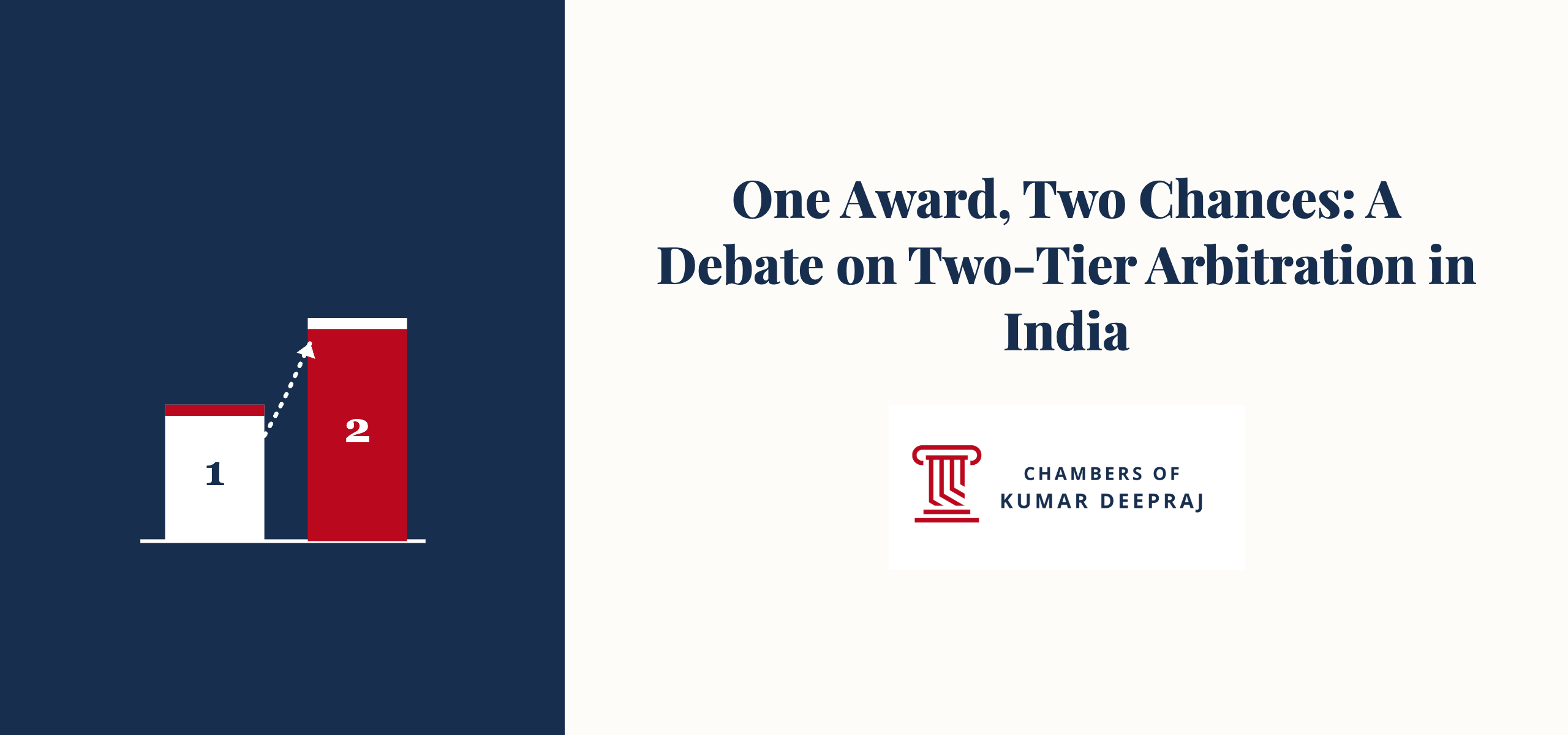
“Two-tier arbitration” is a specific and narrower idea than it sounds. It does not describe the ordinary architecture of Indian arbitration, in which an award can be challenged under Section 34 and, if that challenge fails or succeeds, appealed further under Section 37, because that challenge is not a rehearing on the merits at all. A court exercising Section 34 jurisdiction cannot reappreciate evidence or substitute its own view of the contract for the tribunal’s; it can only set the award aside on a closed list of grounds – incapacity, invalid arbitration agreement, want of notice, excess of jurisdiction, patent illegality, or conflict with the public policy of India. Two-tier arbitration means something else: a contractual arrangement under which the parties agree, in advance, that a dissatisfied party may take the award to a second arbitral tribunal, which then decides the dispute afresh, or substantially afresh, and it is that second award, not the first, that the parties are ultimately bound by.
The practice has old roots in commodity trading, where organisations such as the Grain and Feed Trade Association (GAFTA) and the Federation of Oils, Seeds and Fats Associations (FOSFA) in London have for decades built a right of appeal into their standard arbitration rules: a first-tier award, often delivered quickly by a sole trade arbitrator chosen for market expertise rather than legal training, followed by a right to take the matter to a standing Board of Appeal. The clause at the centre of the Centrotrade litigation borrowed the same logic without borrowing the same institution. It sent a dissatisfied party not to a standing appeal board but to a fresh arbitration under the Rules of the International Chamber of Commerce, seated in London. What both models share is the essential point: the “appeal” stays inside arbitration. No court sits at either tier. It is worth holding onto this distinction because, as this piece will come to, Justice Nariman’s recent proposal does not share it, his is a proposal to strengthen the court’s look at an award, not to add a second arbitrator’s look at it, and calling both ideas “two-tier arbitration” risks collapsing a difference that matters a great deal to how each would actually work.
A Statute That Says Nothing: The 1996 Act’s Studied Silence
Nothing in the Arbitration and Conciliation Act, 1996 provides for an internal, tribunal-to-tribunal appeal. Part I of the Act contemplates one arbitral tribunal, one award, and a challenge to that award confined to Section 34’s closed grounds. When Hindustan Copper Limited resisted the enforcement of the second-tier ICC award in the Centrotrade litigation, its argument traded precisely on this silence: if the Act’s scheme is a single award subject only to a Section 34 challenge, parties should not be permitted to contract their way to something the statute does not contemplate, a second, substantive re-arbitration that effectively displaces the first award and, with it, the only form of scrutiny the statute prescribes.
The answer that eventually prevailed, and it took the Supreme Court until 2016 to give it clearly, was that a statute’s silence about a practice is not the same as a statute’s prohibition of it, at least where the practice in question adds to party autonomy rather than subtracting from it. Nothing in the Act stops parties from choosing a three-member tribunal over a sole arbitrator, an institutional seat over an ad hoc one, or a foreign-seated tribunal over a domestic one; by the same logic, nothing stops them from agreeing that a first award will not be final until it has survived a further, contractually chosen arbitral check. What the Act does insist upon, whichever tier of arbitration the parties have built for themselves, is that the award that finally emerges remains subject to the ordinary safeguards at the enforcement stage; Section 34 for a domestic award, Section 48 for a foreign one. Two-tier arbitration, on this reading, multiplies the arbitral process without multiplying the state’s own supervisory role. Getting the Supreme Court to say so as clearly as that, however, took three rounds of litigation and the better part of a generation.
Centrotrade I: A Split Verdict Born Of A Trading Clause (2006)
The dispute arose out of an ordinary commercial contract: Centrotrade Minerals & Metal Inc., a US company, agreed to sell Hindustan Copper Limited, an Indian public sector undertaking, 15,500 dry metric tonnes of copper concentrate. Clause 14 of that contract carried the two-tier arrangement, disputes were to be settled first by arbitration in India under the Rules of the Indian Council of Arbitration, but if either party was dissatisfied with that result, it had the right to a second arbitration in London under the ICC Rules. A dispute duly arose over the dry weight of the goods delivered. The Indian Council of Arbitration tribunal delivered a nil award on 15 June 1999, rejecting Centrotrade’s claim outright. Centrotrade invoked the appeal clause on 22 February 2000, and the ICC arbitration that followed in London produced, on 29 September 2001, a reasoned award largely in Centrotrade’s favour.
Hindustan Copper resisted enforcement of that award in India, and the matter reached the Calcutta High Court, where a single judge allowed enforcement on 10 March 2004, only for a Division Bench to reverse that finding on 28 July 2004 and hold the ICC award unenforceable. The appeal that followed produced, on 9 May 2006, one of the more unusual outcomes in Indian arbitration reporting: a two-judge Bench that agreed on the result but for entirely irreconcilable reasons, reported as Centrotrade Minerals & Metal Inc. v. Hindustan Copper Ltd., (2006) 11 SCC 245.[3] S.B. Sinha, J. held that the two-tier clause was “non est” in the eye of law and invalid under Section 23 of the Indian Contract Act, 1872, reasoning that the 1996 Act contemplated one arbitral award, not a layered structure governed by two different sets of rules. On his view, Centrotrade’s appeal had to fail because the very clause it relied on was void. Tarun Chatterjee, J. disagreed on that question entirely: in his view, the two-tier structure was valid, the London arbitrator had genuinely sat in appeal, and the ICC award was accordingly a proper foreign award. Yet Chatterjee, J. dismissed Centrotrade’s appeal all the same, on an altogether different ground, that Hindustan Copper had not been able to effectively present its case before the ICC arbitrator, in the disputed aftermath of the 11 September 2001 attacks in New York. Two judges, agreeing on nothing that mattered in principle, nonetheless arrived at the same bottom line, and an appeal decided by an evenly divided Bench left the pure question of law: Is a two-tier arbitration clause valid at all? It was formally unanswered and referred onward for resolution by a larger Bench. That reference would sit, largely undisturbed, for the following decade.
Centrotrade II: The Reference Answered (2016)
It fell to a three-judge Bench of Madan B. Lokur, R.K. Agrawal and D.Y. Chandrachud, JJ. to finally answer the question Sinha and Chatterjee, JJ. had left open. On 15 December 2016, reported the following year as Centrotrade Minerals & Metal Inc. v. Hindustan Copper Ltd., (2017) 2 SCC 228[4], the Bench held, unanimously, that a two-tier arbitration clause of this kind is valid and enforceable under the 1996 Act and does not offend the public policy of India. The reasoning returned to party autonomy as the animating idea of the Act: if parties are free to shape almost every other feature of their arbitration by agreement, there is no principled reason to treat an agreed second arbitral check on the first award as something the Act implicitly forbids, particularly where, as here, the second tier does not remove any of the safeguards the Act or the New York Convention otherwise supply at the enforcement stage.
It is easy to describe this as “the Centrotrade judgment” in the singular, but the 2016 ruling in fact answered only the first of two questions the reference had posed, validity, and the appeals themselves were relisted for consideration of the second: whether the ICC award, now accepted as validly rendered, could actually be enforced against Hindustan Copper’s continuing objections. In other words, ten years after the split verdict, Centrotrade had won the point of law and still did not have its money. That would take almost four years more.
Centrotrade III: The Award Finally Enforced (2020)
On 2 June 2020, a Bench of R.F. Nariman, S. Ravindra Bhat and V. Ramasubramanian, JJ., speaking through Nariman, J., closed the file. Hindustan Copper’s surviving objection was the same one Chatterjee, J. had accepted in 2006: that it had been “unable to present its case” before the ICC arbitrator within the meaning of Section 48(1)(b) of the Act, the natural-justice ground borrowed from the New York Convention. Nariman, J.’s Bench framed the test as whether “factors outside the party’s control” had combined to deny Hindustan Copper a fair hearing, and, going back through the correspondence, found none. Hindustan Copper had been given repeated extensions; it had simply chosen not to appear before the arbitrator and later chosen to submit documents and legal argument outside the timelines it had itself been granted. As for the 11 September 2001 attacks, the specific disruption Hindustan Copper had relied on throughout, the Bench found that its submissions had in fact reached the arbitrator within days and had been duly considered. The judgment went further and held that Chatterjee, J.’s 2006 finding on this very point had rested on “several errors of fact.” Centrotrade’s appeal was allowed, Hindustan Copper’s was dismissed, and the foreign award was enforced, some twenty-one years after the original ICA tribunal had ruled against Centrotrade in the first place.[5]
There is a certain irony worth pausing on. The judge who, in September 2026, would stand up in Gandhinagar and argue that ordinary domestic awards deserve a fuller second look from a court, is the same judge who wrote the final word ensuring that a two-tier arbitral award, built entirely by the parties’ own contract, with no court anywhere in its design, was actually allowed to mean something. Justice Nariman’s more recent instincts about appellate scrutiny did not arise in a vacuum; he has, in a real sense, presided over both ends of this debate.
What Centrotrade Actually Decided And What It Left Open
It has become common, in commentary on this litigation, to say that “Centrotrade recognises appellate arbitration in India,” as though the case supplies a ready-made template for anyone who wants one. It does not. What Centrotrade supplies is a permission: parties may, if they choose to write the clause carefully enough, route their dispute through a second arbitral tier before it becomes final. The judgment says nothing about how that second tier ought to conduct itself, whether it must rehear the dispute entirely afresh, as the ICC arbitrator in London in fact did, delivering a wholly new reasoned award, or whether the parties could instead design a more confined form of review, limited to specified errors in the first award. That question was never before the Court, because Centrotrade’s and Hindustan Copper’s own clause, and the ICC Rules they had chosen to govern the second tier, answered it for them.
This matters more than it might first appear to. Every party that wishes to build a two-tier clause today has to draft the entire second tier from scratch, its scope, its procedure, its relationship to the first award and then hope that a future court reads the result as generously as the Supreme Court eventually read Centrotrade’s. There is no statutory scaffolding to fall back on, no default rules to fill the gaps an imperfectly drafted clause leaves open, and no institutional machinery of the kind GAFTA and FOSFA maintain for their own standing Boards of Appeal. It is precisely this gap, a validated practice without a statutory shape, that the draft Arbitration and Conciliation (Amendment) Bill, 2024 now proposes to fill.
Giving It A Statutory Spine: Section 34A Of The Draft Arbitration Bill
On 18th October 2024, the Department of Legal Affairs in the Ministry of Law and Justice invited public comments on a draft Arbitration and Conciliation (Amendment) Bill, 2024, describing its purpose as giving “further boost to institutional arbitration,” reducing court intervention in arbitrations, and ensuring the timely conclusion of arbitral proceedings.[6] Among its most closely debated proposals is a new provision, Section 34A, headed “Appellate Arbitral Tribunal,” which reads in its operative part:
“(1) The arbitral institutions may, provide for an appellate arbitral tribunal to entertain applications made under Section 34, for setting aside an arbitral award. (2) The appellate arbitral tribunal while deciding an application under Section 34 shall follow such procedure, as may be specified by the Council.”[7]
The mechanism the draft builds around this provision is an opt-in, exclusive-forum design rather than an additional remedy layered on top of the existing one. The proposed amendment to Section 34(1) would allow an award to be set aside “by the Court or an appellate arbitral tribunal, as the case may be,” and where the parties have agreed to take recourse to an Appellate Arbitral Tribunal, the draft is explicit that “no application for setting aside an arbitral award shall lie before the Court”, i.e., the AAT, once chosen, displaces the court’s Section 34 jurisdiction entirely rather than sitting alongside it. A further round of scrutiny is not thereby lost altogether: the draft’s amendment to Section 37 would permit an appeal from an AAT’s decision to the ordinary courts, so an AAT ruling feeds back into the regular appellate ladder one step removed, rather than becoming the last word in itself. A related, if conceptually distinct, reform travels alongside this one, a proposed new sub-section to Section 34 that would let a court (or, presumably, an AAT) remand a partially set-aside award back to the original tribunal, to be reconsidered only to the extent it was set aside, rather than forcing the parties to start a fresh arbitration over issues that were never actually in dispute. Both proposals point the same way: toward keeping arbitral tribunals, in one form or another, involved in a dispute for longer after an award than the present Act allows.
Section 34A’s proponents describe it as the natural legislative sequel to Centrotrade: a private practice the Supreme Court had already found lawful, now given a statutory shell so that arbitral institutions can offer it as a standard feature of their rules rather than something every drafter must build unaided. Framed that way, it is a plausible and even modest step. Framed the other way, as commentators reviewing the draft have not hesitated to do. It also happens to be the first time Indian legislation would authorise a body of arbitrators, rather than a court, to decide finally (subject only to a Section 37 appeal) whether another tribunal’s award should be set aside on public-policy or similar grounds that have traditionally been treated as matters of state supervision over arbitration, not matters arbitration supervises for itself.
The Bill’s Loose Ends
The draft, as things presently stand, leaves a good deal to be filled in later, and reviewers who have gone through it clause by clause have not been shy about listing the gaps. Nowhere does the Bill specify how an Appellate Arbitral Tribunal is actually to be constituted. How many members it should have, who appoints them, or what happens where an institutional arbitration’s own rules provide for an AAT but the same institution that appointed the original tribunal would also be appointing the appellate one, an arrangement that invites exactly the kind of perception problem independence norms exist to avoid. Nor does the draft supply a default rule for the many arbitrations, ad hoc ones especially, where the parties have not agreed on an AAT at all, or have agreed to one only after a dispute has already arisen; commentators have warned that this “legislative vacuum invites forum shopping,” with an award-debtor free to pick whichever of the two available forums, court or AAT, looks more favourable at the time, generating exactly the kind of satellite litigation the reform is meant to prevent.
A more structural gap concerns arbitrator independence. Sections 12 and 13 of the Act, together with the Fifth, Sixth and Seventh Schedules, set out disclosure obligations and disqualifying relationships for arbitrators; the draft does not say, one way or the other, whether these provisions apply to the members of an Appellate Arbitral Tribunal. That is an odd silence for a body that will sit in judgment on another tribunal’s award, surely quintessentially adjudicatory work, and the omission risks either a constitutional vulnerability or a scramble of independence challenges consuming the very one-year timeline Section 34 proceedings are meant to respect. Then there is the question the Bill leaves almost entirely to subordinate rule-making: Section 34A(2) hands the “Council”, i.e., the Arbitration Council of India, the task of specifying the AAT’s procedure, without saying whether that procedure will mirror Section 34’s own narrow grounds of challenge or permit something closer to a fuller merits review. Different Councils, or different institutional rules made under this power, could easily produce different answers to that question for different arbitrations, generating precisely the “two divergent streams of jurisprudence”, one built by courts under Section 34 and 37, the other inside private, frequently unreported AAT proceedings, that reviewers have flagged as the proposal’s least examined risk. Private hearings that produce no public record are, after all, a poor foundation for the “uniform and predictable” body of law that institutional arbitration is supposed to be building.
None of this is a case against Section 34A as an idea. It is a case that the idea, as presently drafted, has been asked to do more work than its text can currently bear, a sound instinct that has outrun its own drafting.
The Same Anxiety, A Different Forum: Justice Nariman’s Case For A First Appeal
Justice Nariman’s remarks at GHAC Arbitration Week 2026 did not engage with Section 34A at all. They began instead from a different complaint: that a run of recent Supreme Court rulings on arbitration, several of them from larger Benches specifically convened to settle unsettled questions, have not in fact settled very much. He pointed to the Constitution Bench’s ruling in Cox and Kings Ltd. v. SAP India Pvt. Ltd. on the “group of companies” doctrine, which turned the inquiry back to whether a non-signatory genuinely consented to be bound rather than treating corporate affiliation on its own as sufficient; to the trilogy running through SMS Tea Estates, Garware Wall Ropes and N.N. Global Mercantile on whether an unstamped instrument can contain a valid arbitration agreement, a question that travelled through successive larger Benches without, in his assessment, producing lasting certainty; to Delhi Metro Rail Corporation Ltd. v. Delhi Airport Metro Express Pvt. Ltd., where he expressed unease at the use of curative jurisdiction to reopen an award on the footing of a “miscarriage of justice”; to Gayatri Balasamy v. ISG Novasoft Technologies Ltd. on whether Section 34’s power to “set aside” an award carries within it a narrower power to modify one, a decision he described, memorably, as “a storm in a teacup,” while cautioning that any judicial tweaking of an award should be confined to what is genuinely clerical or typographical and never allowed to touch anything that “goes to the root”; and to the line of authority culminating in Central Organisation for Railway Electrification v. ECI-SPIC-SMO-MCML (JV) on unilateral arbitrator appointments by one party to a contract. His overall verdict was blunt: “According to me not particularly well, because firstly the judgments don’t conduce to certainty.”[8]
His proposed remedy was equally direct. Scrap the single-judge stage of a Section 34 challenge altogether, and send domestic awards straight to a Division Bench of the High Court, empowered to conduct “a full-fledged appeal on both facts and law at one stage,” with only the Supreme Court’s jurisdiction lying beyond that. He proposed a three-stage timeline, an award delivered within a prescribed period, a Division Bench appeal completed within a further prescribed period, and only then, if at all, the Supreme Court, though the address, as reported, did not commit to specific durations for each stage. His underlying premise is worth stating in his own words: “Today, according to me, not only should there be speed, cost-effectiveness, there has to be accuracy,” on the reasoning that Indian arbitration, three decades into the 1996 Act, is no longer confined to the “rough justice” a trusted local arbitrator might deliver between familiar parties, but now routinely resolves disputes between sophisticated commercial entities over very large sums, disputes, in his view, that deserve the same standard of accuracy a trial court’s judgment is expected to meet, and a single judge’s limited Section 34 scrutiny, in his assessment, simply takes years to deliver that without actually delivering the accuracy in return.[9]
It is worth restating plainly what this proposal is not. It is not a second arbitration, and it does not sit inside the same family as Centrotrade or Section 34A at all, it is a proposal to restructure what happens at the court stage, replacing a single judge’s narrow review with a Division Bench’s full merits appeal. Justice Nariman was not alone at GIFT City in sensing that the pendulum has swung too far toward a narrow post-award review: Justice M.R. Shah, at the same conference, spoke in favour of “a forum capable of exercising appellate scrutiny over questions of law and fact in appropriate circumstances.” Others pushed back from a different angle. Justice Tejas Karia cautioned that “the first priority should be improving the quality of arbitration” itself, rather than building a larger appellate structure to catch its failures after the fact, a reminder that a more searching post-award check, however designed, is at best a remedy for bad outcomes, not a substitute for better arbitration in the first place.
“Why Have Arbitration At All?”: Justice Raveendran’s Rebuttal
Justice Raveendran’s response, delivered at the same conference two days later, went to the root of the proposal rather than its details. “If you have a first appeal, then why have an arbitration? The entire purpose of arbitration is to have finality,” he is reported to have said, adding that expanding appellate powers over arbitral awards would strip arbitration of the very feature that distinguishes it from ordinary litigation. He paired this with a pointed observation about the Supreme Court’s own contribution to the uncertainty Justice Nariman had catalogued, describing the Court as functioning, in practice, as “seventeen separate entities”, a court whose different Benches do not always speak with one voice, which is itself no small part of why questions like the group-of-companies doctrine or the modification power needed larger Benches to sort out in the first place.
Raveendran’s objection deserves to be taken seriously on its own terms, not dismissed as institutional loyalty to a system he helped build. A full appeal on both facts and law before a Division Bench is, in substance, very difficult to distinguish from an ordinary first appeal under Section 96 of the Code of Civil Procedure against a trial court’s decree. If every domestic award is to receive that kind of review as of right, what survives of the bargain the parties actually made when they chose arbitration, a single, largely conclusive adjudication, selected by agreement, precisely in order to avoid the layered appellate structure of ordinary civil litigation? What would remain is a private trial court whose judgment happens to be called an award, followed by exactly the appellate ladder an ordinary suit would have climbed regardless. That is not a small semantic quibble; it goes to why parties choose arbitration in the first place, and a reform that quietly converts every arbitration into litigation-with-extra-steps risks making arbitration a less attractive choice for the very commercial parties Justice Nariman says he wants to serve better. At the same time, his underlying diagnosis should not be waved away either, a Supreme Court that produces genuinely divergent answers to the same question across successive larger Benches is a real problem, just not obviously one that is solved by building a further appellate rung beneath it. If Constitution Benches convened specifically to settle these questions have struggled to produce lasting certainty, there is little reason to expect dozens of Division Benches spread across twenty-five High Courts to do better on the same questions, case by case; Raveendran’s “seventeen separate entities” jibe about the Supreme Court would, if anything, apply with still greater force to a system built around Division Bench appeals, with an already overburdened Supreme Court left to reconcile whatever divergence results, one special leave petition at a time.
Two Models, One Anxiety: Comparing The Arbitral And Judicial Routes
Set side by side, the AAT proposal and Justice Nariman’s Division Bench proposal turn out to answer the same discomfort, that a single award, checked only by a narrow Section 34 review, does not always feel like enough, in almost opposite ways. Section 34A is triggered only where the parties themselves have agreed to it, through an arbitral institution’s rules; nothing in the draft forces an AAT on parties who never asked for one. Justice Nariman’s proposal, as described at GIFT City, carries no such opt-in. It would restructure what every domestic award receives at the court stage, whether or not the parties who chose arbitration ever wanted a full merits appeal built into it. Section 34A also keeps the second look inside arbitration’s own institutional culture, a panel of arbitrators, presumably appointed the way arbitrators are appointed, applying arbitral procedure; Justice Nariman’s forum is unambiguously a court, staffed by sitting judges, applying the ordinary civil appellate process.
That difference is not merely structural; it goes to which proposal sits more comfortably with what the Supreme Court actually decided in Centrotrade. Section 34A is the more faithful descendant of that judgment. It simply gives statutory shape and institutional support to a choice parties were already found free to make for themselves. Justice Nariman’s proposal does not ask for the parties’ agreement at all; it would change, as a matter of general law, what a domestic arbitral award is worth until a Division Bench has had a full look at it. The risks the two proposals carry are correspondingly different in kind. Section 34A’s problems, catalogued above, are drafting problems, how an AAT is appointed, whether independence norms apply to it, how its scope of review is fixed, real, but fixable with a better-drafted second attempt at the Bill. The risk in Justice Nariman’s proposal is more fundamental, because it is not a drafting defect but the design itself: a full merits appeal, available as of right, is very hard to reconcile with arbitration remaining meaningfully different from litigation, which is precisely Justice Raveendran’s objection and precisely the reason many commercial parties choose arbitration to begin with.
None of this is to say Justice Nariman’s underlying complaint is wrong, a Supreme Court whose own larger Benches struggle to produce lasting certainty on basic questions is a genuine institutional problem, and one this author has no difficulty agreeing is worth solving. But the more promising fix for that particular problem looks less like adding a further appellate tier beneath the Supreme Court, and more like discipline exercised where the inconsistency actually originates, fewer, more carefully sequenced references to larger Benches, and judgments in those references drafted with an eye to actually closing the question rather than leaving room for the next reference. Between the two live proposals actually on the table in India today, Section 34A, imperfect, underspecified, and in need of real redrafting as it is, remains the more coherent answer, because it leaves the choice of a second look exactly where arbitration has always left every other choice: with the parties. It is telling, and perhaps a sign of how early this conversation still is, that neither proposal currently engages with the other at all, the draft Bill does not mention a Division Bench alternative, and Justice Nariman’s GIFT City remarks made no reference to Section 34A. India’s arbitration reform debate, on this question at least, is still at the stage of competing diagnoses rather than a converged prescription.
Comparative Glimpses: How Other Systems Handle The Second Look
India’s domestic debate is a local instance of a question arbitration systems elsewhere have also had to confront. The commodity trade world answered it long ago in the way Section 34A gestures toward: GAFTA and FOSFA have for decades built a standing Board of Appeal into their own rules, so that an appeal from a first-tier award stays inside the same institutional family rather than spilling into court, precisely the tradition the Centrotrade clause borrowed, informally, when it sent a dissatisfied party from an Indian first tier to an ICC-administered second tier in London. Mainstream international institutional rules take the opposite default position: the ICC and the LCIA provide no internal appeal at all, treating a single, final award as the ordinary bargain of arbitration unless the parties’ own clause, as in Centrotrade, chooses to build something more elaborate on top of it.
At the investment-treaty level, the same anxiety has a close and long-running cousin. The ICSID Convention’s Article 52 annulment mechanism has never functioned as a merits appeal, an ad hoc Committee may annul an award only on narrow, largely procedural grounds, such as a tribunal manifestly exceeding its powers, corruption, a serious departure from a fundamental rule of procedure, or a failure to state reasons, precisely so that annulment does not become a disguised third round on the merits. Dissatisfaction with how narrow that safety valve actually is has been a significant part of what has kept UNCITRAL’s Working Group III occupied for close to a decade with the far more ambitious idea of a standing, multilateral appellate mechanism for investor-State awards, a project that, as of its most recent sessions in 2026, remains at the stage of draft statutes for a permanent tribunal and a permanent appellate body, rather than a concluded, adopted instrument.[10] Seen against that international backdrop, India is not asking an unusual question by wondering whether one-shot finality still suits every arbitration it now hosts; it is simply late to a conversation the commodity trade world settled generations ago and the investment-treaty world is still, slowly and multilaterally, trying to have.
Conclusion
Three strands, then, all responding to the same discomfort with treating a single arbitral award, checked only by a narrow Section 34 challenge, as the last word in a high-value commercial dispute and, at present, none of them speaking to the others. Centrotrade settled, after twenty years and three rounds of litigation, that parties are free to build a second arbitral tier into their own contract if they choose to, though it supplied a permission rather than a template, leaving every future drafter to build that second tier unaided. Section 34A of the draft Bill would, for the first time, offer a ready-made statutory version of the same idea, a meaningful step, but one whose appointment, independence, and scope-of-review gaps need real attention before institutional users can rely on it with confidence. And Justice Nariman’s proposal at GIFT City points somewhere else entirely: not toward a second arbitration, but toward a fuller judicial appeal in place of today’s Section 34 challenge, a solution Justice Raveendran’s blunt question forces every proponent to answer squarel, if an arbitral award is to receive a genuinely fresh first appeal on facts and law, at what point does calling the underlying process “arbitration” become simply a matter of habit?
For practitioners drafting contracts today, only Centrotrade is settled law, and a carefully drafted two-tier clause will be enforced. For those watching Parliament, Section 34A is a promising but unfinished idea. And for those who share Justice Nariman’s frustration with the unpredictability of recent Supreme Court arbitration jurisprudence, a frustration this author largely shares, the more durable fix may lie less in adding another appellate rung beneath the Supreme Court, and more in the discipline the Supreme Court exercises over itself when it agrees to settle a question in the first place.
[1]Justice R.F. Nariman’s address at GHAC Arbitration Week 2026, Gujarat High Court Arbitration Centre, GIFT City, Gandhinagar, 4 September 2026, as reported in “Supreme Court’s recent arbitration rulings have created grave uncertainty: Retired Justice Rohinton Nariman,” Bar and Bench, 4 September 2026 (https://www.barandbench.com/news/supreme-courts-recent-arbitration-rulings-have-created-grave-uncertainty-retired-justice-rohinton-nariman); “Justice Rohinton F. Nariman Calls For Direct Division Bench Appeals Against Domestic Arbitral Awards,” LiveLaw, 4 September 2026 (https://www.livelawbiz.com/arbitration/justice-rohinton-f-nariman-calls-for-direct-division-bench-appeals-against-domestic-arbitral-awards-548631); and “Justice R.F. Nariman calls for greater certainty and accuracy in India’s arbitration regime at GHAC Arbitration Week 2026,” SCC Online Blog, 4 September 2026 (https://www.scconline.com/blog/post/2026/09/04/justice-rf-nariman-greater-certainty-accuracy-india-arbitration-regime-ghac-arbitration-week-2026/).
[2]“‘I was shocked’: Justice RV Raveendran disagrees with Justice Nariman on full appeal against arbitral awards,” Bar and Bench, 6 September 2026 (https://www.barandbench.com/news/i-was-shocked-justice-rv-raveendran-disagrees-with-justice-nariman-on-full-appeal-against-arbitral-awards).
[3]Centrotrade Minerals & Metal Inc. v. Hindustan Copper Ltd., (2006) 11 SCC 245 (S.B. Sinha and Tarun Chatterjee, JJ., 9 May 2006).
[4]Centrotrade Minerals & Metal Inc. v. Hindustan Copper Ltd., (2017) 2 SCC 228 (Madan B. Lokur, R.K. Agrawal and D.Y. Chandrachud, JJ., 15 December 2016).
[5]Centrotrade Minerals and Metals Inc. v. Hindustan Copper Ltd. (R.F. Nariman, S. Ravindra Bhat and V. Ramasubramanian, JJ., 2 June 2020); text on file with the UNCITRAL CLOUT case archive (https://www.uncitral.org/res/clout/clout/data/ind/clout_case_2098_html/19375_2004_34_1501_22350_Judgement_02-Jun-2020.pdf).
[6]Ministry of Law and Justice, Press Information Bureau, “Inviting comments on the draft Arbitration and Conciliation (Amendment) Bill, 2024,” 18 October 2024 (https://www.pib.gov.in/PressReleasePage.aspx?PRID=2066081).
[7]Draft Arbitration and Conciliation (Amendment) Bill, 2024, proposed Section 34A. At the time of writing, the draft remains at the pre-legislative, public-consultation stage and has not been introduced in Parliament.
[8]As catalogued in Justice Nariman’s address, GHAC Arbitration Week 2026 (see note 1 above), referring to Cox and Kings Ltd. v. SAP India Pvt. Ltd. (group of companies doctrine, December 2023); the trilogy of SMS Tea Estates (P) Ltd. v. Chandmari Tea Co. (P) Ltd., Garware Wall Ropes Ltd. v. Coastal Marine Constructions & Engineering Ltd. and N.N. Global Mercantile Pvt. Ltd. v. Indo Unique Flame Ltd. (unstamped arbitration agreements); Delhi Metro Rail Corporation Ltd. v. Delhi Airport Metro Express Pvt. Ltd. (curative jurisdiction, 2024); Gayatri Balasamy v. ISG Novasoft Technologies Ltd. (modification power under Section 34, 2025); and Central Organisation for Railway Electrification v. ECI-SPIC-SMO-MCML (JV) (unilateral arbitrator appointment).
[9]Ibid.
[10]“UNCITRAL Working Group III Advances ISDS Reform but Progress Remains Slow,” Investment Treaty News, International Institute for Sustainable Development, 21 April 2026 (https://www.iisd.org/itn/2026/04/21/uncitral-working-group-iii-advances-isds-reform-but-progress-remains-slow/).