Introduction: When Business Disputes Reach the Courts
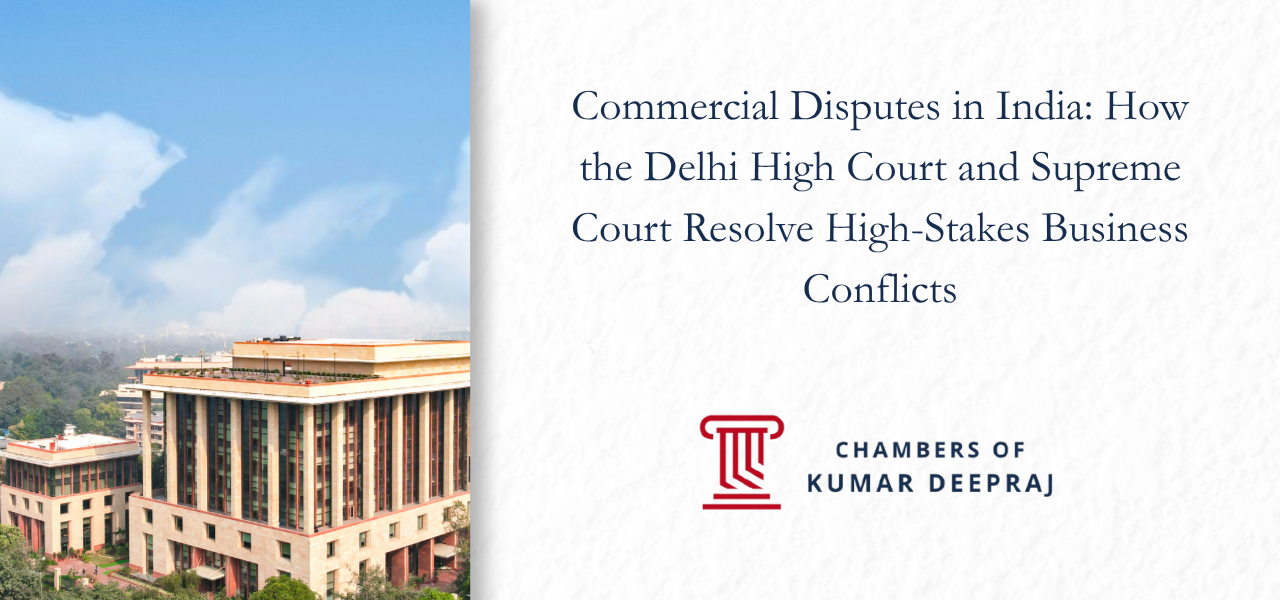
Every business engagement comes with an inherent risk of a possible dispute, whether it be a misunderstanding over the terms of the contract, withholding payment, violation of trust by a fiduciary, or regulatory transgression. In India, if these disputes are not resolved through business negotiation, they end up in one of the most important courts in the country – the Commercial Division of the Delhi High Court, or even, at the highest echelons, the Supreme Court of India.
The importance of winning such litigation cannot be overstated, for reputation, finances, freedom, and even survival may depend on the legal representation of choice. This article looks at how complex commercial, civil, and corporate disputes are argued in the best courts in the country, and what you need to know before stepping into this arena.
The Commercial Courts Act 2015: India’s Dedicated Framework for Business Disputes
Until 2015, all commercial disputes in India were heard by regular civil courts, causing the process to take several years – even decades at times. The enactment of The Commercial Courts Act 2015 was one such revolutionary step which made a drastic difference.
This Act provided for the creation of Commercial Courts as well as Commercial Divisions of High Courts, wherein the Commercial Division of Delhi High Court is among the busiest commercial divisions in the entire country. The main motive behind its enactment was to facilitate speedy disposal of commercial disputes having a certain monetary value, i.e., above INR 3 lakhs.
What Qualifies as a “Commercial Dispute”?
Under the Act, a commercial dispute includes, among others, disputes arising from:
-
- Mercantile documents like bills of exchange, promissory notes, letters of credit
-
- Ordinary transactions of merchants and traders
-
- Insurance and re-insurance contracts
-
- Export and import of goods or services
-
- Franchise and distribution agreements
-
- Admiralty and maritime law
-
- Shareholder agreements and joint venture agreements
-
- Intellectual property rights (including trademarks, patents, and copyright)
-
- Construction and infrastructure contracts
-
- Agreements relating to immovable property used exclusively in trade or commerce
Significantly, disagreements that may emanate from agreements between partners and agreements involving subscriptions and investments in the businesses become part of commercial disputes, hence, the Commercial Division becomes the best place to solve such business-related issues between parties.
The Delhi High Court: Original and Appellate Jurisdiction in Commercial Matters
The Delhi High Court stands out in its own right within the judicial system of India. One of the unique features about this High Court is that it falls under the purview of Original Civil Jurisdiction, which means that it can exercise its powers directly to settle civil cases.
Original Side Jurisdiction
For suits valued above INR 2 crore (in commercial matters), the Delhi High Court’s Commercial Division exercises original jurisdiction. This is particularly significant for:
-
- IP infringement — Seeking immediate relief against passing off, trademark infringement, or copyright violations
-
- Contract enforcement — Enforcing high-value agreements where one party has defaulted
-
- Recovery suits — Recovering dues, outstanding invoices, or loan amounts from defaulting parties
-
- Injunctions — Obtaining urgent interim relief to prevent irreparable harm (e.g., restraining a party from dealing with disputed assets, disclosing confidential information, or breaching a non-compete covenant)
Summary Judgment Under Order XIII-A
Among the most effective procedural instruments brought about by the Commercial Courts Act is Order XIII-A of the Code of Civil Procedure, which refers to the summary judgment process. The claimant (or the respondent in case of a counterclaim) may request for the claim to be disposed of summarily without going through the entire trial process if the court is convinced that there is no chance at all that the opponent will prevail in his or her defense.
Appellate Jurisdiction
The Commercial Appellate Division of the High Court hears appeals against any decision made by the Commercial Court under the Delhi High Court’s jurisdiction, as well as any arbitral award. The appeals on arbitral awards filed under Section 37 of the Arbitration and Conciliation Act 1996 and applications for setting aside an award under Section 34 are entertained here; thus, knowledge of arbitration and commercial law becomes imperative.
The Supreme Court of India: The Apex Forum for Civil and Commercial Appeals
The Supreme Court of India represents the final word in the country’s judicial hierarchy. For commercial and civil litigants, two principal routes lead to the Supreme Court:
Special Leave Petition (SLP) Under Article 136
The SLP is the most common mode of accessing the Supreme Court, whereby parties seek special leave to appeal against any judgment, order, or decree made by any court or tribunal in India. The Supreme Court has the prerogative to accept or reject such a plea, and in commercial cases, the intervention of the Supreme Court is sought in cases of:
-
- Substantial questions of law
-
- Differences of opinion between various High Courts
-
- Orders issued by a High Court which create grave injustice or irreversible prejudice
It would not be an exaggeration to emphasize the significance of appellate advocacy at the SLP level. The SLP requires that intricate factual situations and complex legal issues be presented in a clear and lucid form due to the fact that, based on the petition and brief oral arguments, the Supreme Court makes its decision.
Writ Jurisdiction Under Article 32
Where the basic right is involved, which includes business cases where there is arbitrary action by the State, over-regulation, or violation of the right to conduct any business under Article 19(1)(g) of the Constitution, a case can be made directly to the Supreme Court under Article 32 via a Writ Petition. The route is often taken in relation to:
-
- SEBI, RBI, or IRDAI regulation that is deemed arbitrary and excessive
-
- Government contract and tender issues that raise public law issues
-
- License/permit revocation that affects businesses
White Collar Crime Defence: A Distinct and Critical Practice Area
However, the boundary between aggressive business practices and criminal prosecution in India is now being determined by a variety of laws carrying significant penalties. White-collar crime, which can be described generally as financially motivated crime that does not involve violence carried out by an individual, corporation, or public official, is now taken seriously in India.
Key Statutes in India’s White Collar Enforcement Landscape
The Fugitive Economic Offenders Act 2018 (FEOA)
To prevent the exit of economic offenders from the country to avoid legal consequences, the FEOA authorizes a court to designate an individual as a FEO in cases where the value of the offence exceeds INR 100 crores and the individual leaves India or avoids returning to India. The repercussions are stringent in that all the assets belonging to the individual declared as a FEO, regardless of whether they have been procured by proceeds of crime or benami assets, will be seized.
The Prevention of Money Laundering Act 2002 (PMLA)
Litigation involving the Prevention of Money Laundering Act (PMLA) has become one of the most significant types of litigation in the white-collar sector in India. With the provisions for asset seizure, arrest without a warrant from a magistrate, and reverse onus of proof (where the accused must prove that the assets are not proceeds of crime), cases under the PMLA are some of the most complicated and significant litigations in India.
The Prevention of Corruption Act 1988 (as amended 2018)
For business professionals dealing with the government in procurement, licensing, regulatory approvals, or PPPs, corruption charges under the Prevention of Corruption Act come with serious implications, including jail time. In 2018, the act was amended to include a wider interpretation of “undue advantage” and to provide a means of punishing bribe givers as well as receivers.
Cheque Dishonour Under Section 138 of the Negotiable Instruments Act
Despite falling within the lower ranks of white-collar crimes, cases arising under Section 138 NI Act relating to the issuance of dishonoured cheques are a volume business of considerable commercial importance. The imposition of criminal responsibility on dishonoured cheques (up to two years’ imprisonment and fine twice the cheque value) serves as an excellent instrument of enforcement in commercial litigation related to non-payment of dues.
Civil Litigation at the Appellate Level: The Art of the Appeal
All cases do not necessarily start as commercial cases. Valuable civil cases like succession cases, property disputes, failed family settlements, trust and estates disputes, and disputes between partners often end up before the Delhi High Court and the Supreme Court as appeals.
In appeals, the role of advocacy changes completely. The case record has been finalized. The appellate court does not try to re-examine the case; rather, it examines whether the lower court has:
-
- Applied the correct law and applied it correctly
-
- Reached an appropriate decision based on evidence
-
- Ensured that there has been procedural justice
Successful appellate advocacy requires the identification of the key error – where exactly the logic of the lower court began to fail – and building an entire case based on that hinge. The essential tools of the successful appellate advocate include the identification of the correct grounds for appeal, sound writing, and effective oral advocacy.
Why Forum and Advocacy Matter: Choosing the Right Legal Representation
The quality of representation is no less than primary in the context of high profile commercial, civil, and white-collar matters. The following considerations will help in identifying appropriate representation in cases before the Supreme Court of India and the Delhi High Court (Commercial Division):
Knowledge of the forum. Every court has a particular procedural atmosphere and approach, and every court has different administrative concerns. This requires knowledge beyond what can be found in any statute or case law. The ability to navigate these forums effectively is critical.
Factual record acumen. Commercial and civil litigation frequently involve a mountain of documents. Finding out how to locate that pivotal piece of correspondence, that crucial contract provision, or that vital document that settles the dispute is an important advantage.
Legislative and regulatory insight. When the matter involves white-collar defense, regulatory inquiries, or matters pertaining to government agencies, legislative draftsmanship expertise becomes extremely useful.
Appeals judgment. Whether it be knowing when to take up a matter, knowing whether to file an injunction, or whether an SLP would be successful, an appeals-minded attorney will have insight into what decisions need to be made.
Conclusion: Commercial Justice is a Specialist Pursuit
The legal arena of India in regard to business litigation is complex and critical, requiring expert knowledge and skills. It does not matter whether it concerns a contentious commercial agreement, regulatory probe, white-collar crime case, or long-standing civil suit that finally ends up on appeal; the level of legal representation will be key.
As a business or individual dealing with any of these matters, the best time to hire competent legal counsel is not after the initial decision has been made but before the issue arises.