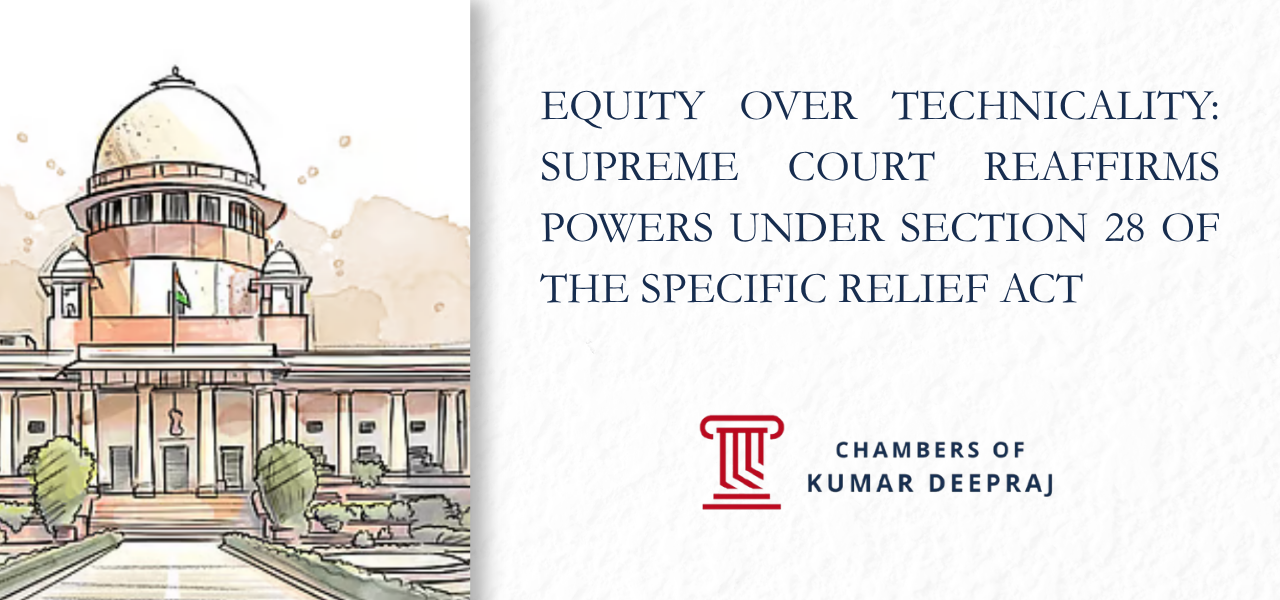
In Sanjay Dwivedi vs. Madanlal Agrawal (2026),[1] the Supreme Court reaffirmed that a decree for specific performance does not automatically stand rescinded merely because the decree-holder fails to deposit the balance sale consideration within the time stipulated in the decree. The Court held that courts retain jurisdiction to extend the time for payment even after expiry of the prescribed period, provided the equities of the case justify such extension. The judgment, delivered by a Bench comprising Justice Manoj Misra and Justice Manmohan, is an important reaffirmation of the equitable foundations underlying decrees for specific performance.
FACTUAL BACKGROUND OF THE CASE
The dispute arose from an agreement executed in 2011 for the sale of approximately 3.75 acres of land at the rate of Rs.16 lakh per acre. A suit for specific performance was instituted after disputes emerged between the parties regarding completion of the transaction. On March 3, 2017, the trial court decreed the suit for specific performance and directed the purchaser to pay or deposit the balance sale consideration of Rs.57.5 lakh within one month. The purchaser subsequently issued a notice calling upon the seller to execute the sale deed and also initiated execution proceedings.
However, the actual deposit of the balance consideration was made only on November 26, 2020, pursuant to directions issued by the execution court. In the meantime, the seller had challenged the decree in appeal, and the appellate proceedings remained pending until 2023, when the appeal was dismissed for non-prosecution. Despite these circumstances, the execution court dismissed the execution proceedings on the ground that the decree-holder had failed to deposit the amount within the stipulated period. The Madhya Pradesh High Court upheld that view. Before the Supreme Court, the appellant contended that the courts below had adopted an unduly technical approach and failed to appreciate the surrounding circumstances, including the pendency of the seller’s appeal and the disruptions caused during the Covid-19 pandemic. It was argued that Section 28 expressly empowers courts to extend the time for deposit and that rescission is not automatic merely because of delay.
RE-DEFINING THE NATURE OF A DECREE FOR SPECIFIC PERFORMANCE
The Supreme Court reiterated a well-settled principle that a decree for specific performance is in the nature of a preliminary decree. Unlike ordinary money decrees, a decree for specific performance does not conclude the jurisdiction of the court once the decree is passed. The court retains supervisory jurisdiction until the sale deed is executed and the transaction is fully completed. This principle becomes particularly important under Section 28 of the Specific Relief Act, which empowers the court to rescind the contract where the purchaser fails to comply with the terms of the decree. Simultaneously, the same provision enables the court to extend time for compliance where circumstances warrant such indulgence. Thus, the power under Section 28 is not merely punitive; it is fundamentally discretionary and equitable in character.
NO AUTOMATIC RESCISSION OF THE CONTRACT
One of the most important aspects of the judgment is the Court’s categorical clarification that non-payment or non-deposit within the stipulated period does not automatically rescind the contract or the decree. The Court observed that many courts have tended to treat the timeline mentioned in decrees for specific performance as rigid and inflexible. Such an approach, according to the Supreme Court, defeats the equitable nature of the remedy itself. The Court clarified that unless the decree specifically states that failure to deposit the amount within the prescribed period would automatically result in rescission of the contract or dismissal of the suit, the decree does not become inexecutable merely because the time period has expired. This distinction is crucial. Where the decree expressly contains a default clause stipulating automatic rescission on non-compliance, the consequences of default follow strictly. However, where no such stipulation exists, the court retains discretion to examine whether time should be extended.
POWER OF COURTS TO EXTEND TIME
The Supreme Court further clarified that an application seeking extension of time for deposit may be made either before or after expiry of the stipulated period. Importantly, the Court held that no specific form is prescribed for seeking such extension. Even a prayer seeking permission to deposit the delayed amount may itself be treated as a request for extension of time. The Court recognised the practical realities of litigation and held that such requests may even be made orally in certain situations, particularly where the execution court itself is dealing with issues concerning compliance with the decree. This approach reflects a pragmatic understanding that procedural technicalities should not override substantive justice. The judgment also clarified the procedural position where the decree is passed by an appellate court. In such cases, the application may still be made before the court of first instance in light of Section 37 of the Code of Civil Procedure.
EQUITY AS THE GOVERNING PRINCIPLE
Perhaps the most significant contribution of the judgment lies in its detailed articulation of the equitable considerations that should guide courts while exercising powers under Section 28. The Court observed that specific performance is inherently an equitable remedy. Therefore, while considering whether to rescind the contract or extend time for compliance, courts must carefully examine the conduct of the parties, surrounding circumstances, and the overall balance of equities.
The Court emphasized that the objective should not merely be to punish delay mechanically. Instead, courts should assess whether the judgment debtor can be adequately compensated for the delay by imposing appropriate terms and conditions upon the decree-holder. This reasoning recognises that delays may occur for multiple reasons, including pendency of appeals, conduct of the opposite party, external disruptions such as the Covid-19 pandemic, or genuine procedural complications. Consequently, the discretion under Section 28 must be exercised judiciously and not arbitrarily.
WILLFUL NEGLIGENCE VERSUS MERE DELAY
The Supreme Court also drew an important distinction between mere delay and willful negligence. The Bench clarified that while every single day’s delay need not be explained in the same strict manner as applications under Section 5 of the Limitation Act, the court must still evaluate the overall conduct of the decree-holder. The decisive test, according to the Court, is whether the conduct of the decree-holder demonstrates an intention not to complete the contract. If the surrounding circumstances reveal deliberate inaction, abandonment of obligations, or willful negligence, the court may legitimately exercise its power to rescind the contract. However, where the delay does not indicate lack of bona fide and the purchaser remains willing to perform the contract, rescission may not be justified. This nuanced approach ensures that Section 28 is not converted into a rigid penal provision.
IMPORTANCE OF TIME STIPULATIONS IN DECREES
The Court also examined the implications of Order XX Rule 12A of the Code of Civil Procedure, which requires courts to specify the period within which payment is to be made in decrees for specific performance concerning immovable property. The judgment clarifies that appellate courts must also fix timelines where they reverse dismissal orders and grant specific performance. Similarly, where appeals against decrees for specific performance are dismissed, the court must indicate the time within which payment is to be made. Interestingly, the Court observed that where no timeline is prescribed, compliance must occur within a “reasonable period,” which would depend upon the facts and circumstances of each case. This observation is particularly relevant because many decrees historically omitted clear timelines, leading to ambiguity during execution proceedings.
WHY THE SUPREME COURT INTERFERED
Applying these principles to the facts of the case, the Supreme Court found that both the execution court and the High Court had failed to exercise their discretion properly.
The Bench noted several relevant factors:
- The execution court itself had repeatedly adjourned the matter and granted opportunities for deposit.
- The seller’s appeal against the decree remained pending for several years.
- The Covid-19 lockdown intervened during the execution proceedings.
- The courts below failed to consider whether the seller could be compensated monetarily for the delay.
Most importantly, the lower courts failed to analyse whether the decree-holder’s conduct truly reflected abandonment of the contract or lack of willingness to perform. Consequently, the Supreme Court held that the dismissal of execution proceedings was unsustainable.
KEY TAKE-AWAY FOR LAW PRACTITIONERS
This judgment has considerable practical importance for litigation involving specific performance of contracts.
- First, it prevents unjust enrichment by judgment debtors who attempt to avoid execution merely by relying upon procedural delays despite continued willingness on the part of decree-holders.
- Second, it reinforces the principle that decrees for specific performance are not to be interpreted mechanically. Since such decrees concern transfer of immovable property and equitable obligations, courts must adopt a balanced and justice-oriented approach.
- Third, the judgment provides much-needed clarity regarding the procedural flexibility available under Section 28. By recognising oral requests and implied prayers for extension of time, the Court has reduced the scope for hyper-technical objections.
- Finally, the decision strengthens judicial consistency by summarizing the governing legal principles in a structured manner, thereby providing clear guidance to subordinate courts across the country.
CONCLUSION
The Supreme Court’s ruling in Sanjay Dwivedi vs. Madanlal Agrawal marks an important reaffirmation of the equitable character of specific performance jurisprudence in India. The judgment decisively rejects the notion that delay in deposit automatically extinguishes rights under a decree for specific performance. Instead, the Court has clarified that Section 28 of the Specific Relief Act vests continuing jurisdiction in courts to balance equities, assess conduct, and determine whether extension of time or rescission would better serve the ends of justice.
[1] Civil Appeal @ SLP (C) No. 14206/2025.