Updated August 2026.
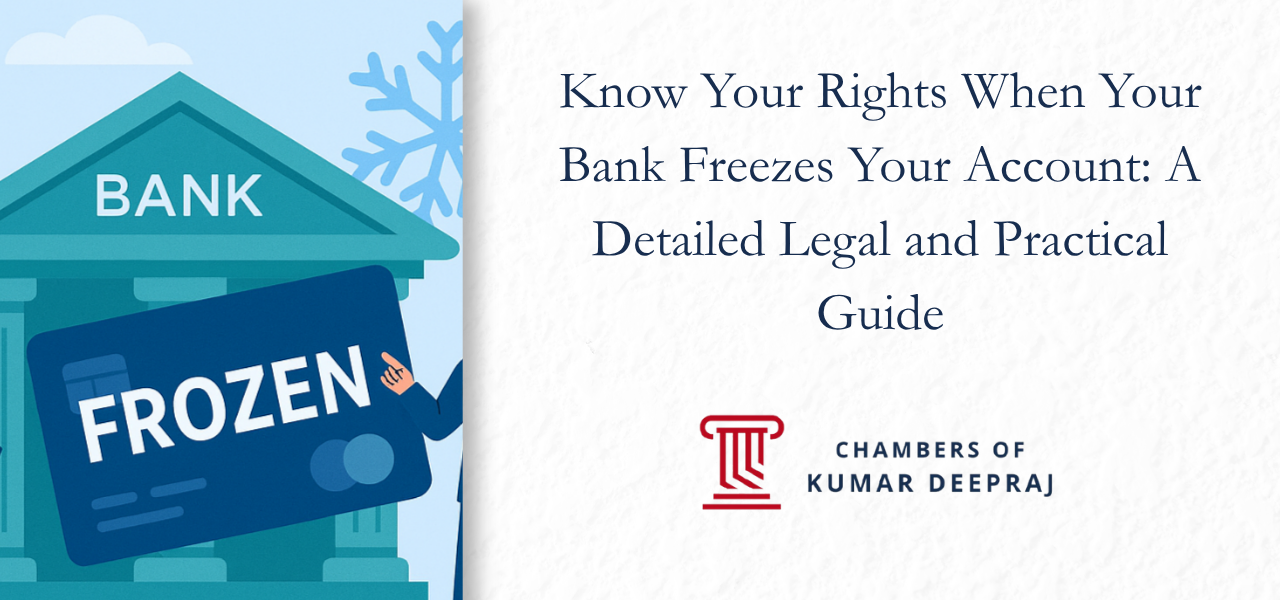
Imagine waking up one morning to find your bank account inaccessible. Your debit card declines; online payments fail. For many, this is not just a financial inconvenience, it’s a full-blown crisis. In a world increasingly dependent on digital banking, the sudden freezing of a bank account can throw an individual or business into chaos. It is not merely a pause in transactions; it can derail loan repayments, payroll disbursements, and EMIs, and disrupt day-to-day life. More crucially, it can infringe on fundamental rights. A frozen account might arise from a regulatory action, a tax notice, enforcement proceedings, or even an incorrect internal flag by the bank. But here’s the good news: you do have rights.
The last twelve months have been the most consequential period in recent memory for this area of law. Faced with a flood of accounts frozen in “digital arrest” and cyber-fraud investigations, the Supreme Court has, through a series of orders, taken direct control of how banks, the police, and the Enforcement Directorate handle suspect accounts, ordering the Reserve Bank of India to frame a nationwide Standard Operating Procedure, mandating grievance-redressal and money-restoration mechanisms in every State, and directing courts to decide freeze-related petitions on a war footing. At the same time, High Courts across the country have split sharply on a question that affects almost every cyber-fraud freeze: can the police freeze your account under Section 106 of the Bharatiya Nagarik Suraksha Sanhita, 2023 on their own, or do they first need a Magistrate’s order under Section 107?
This is not just a summary of laws but a guide to your actual rights, legal strategy, and redress mechanisms, spanning banking regulation, constitutional safeguards, and case-specific tactics, i.e., a roadmap for individuals, businesses, and legal practitioners alike.
What Is a Frozen Account?
A frozen bank account remains open but is rendered inoperable. You cannot withdraw money, issue cheques, or make UPI or card payments or transfers — though deposits may continue unless expressly barred. The bank takes this measure on its own, or on the instruction of an enforcement agency or the judiciary, typically on account of:
> Suspicion of unlawful activity — money laundering, cyber fraud, or an account acting as a “mule” for the proceeds of fraud.
> Regulatory directions — under the Income Tax Act, FEMA, or the PMLA.
> Court or Magistrate’s orders — attachment proceedings.
> The bank’s own internal alerts or error flags — most commonly, KYC non-compliance.[1]
Freezing differs from closing an account: a closed account ceases to exist, while a frozen account continues to accrue interest (where applicable) and to receive deposits, but disallows withdrawals. It is, in principle, a preventive measure pending investigation or further instructions.
The regulatory backdrop here has itself changed materially. The RBI’s 2016 Master Direction on KYC, the instrument this guide previously relied on for the bank’s “reasonable notice” obligation, no longer exists in that form. On 28 November 2025, the RBI repealed it as part of a sweeping consolidation exercise in which roughly 3,500 circulars and directions were folded into 238 subject and sector-specific Master Directions.[2] Bank-account KYC is now governed by the Reserve Bank of India (Commercial Banks – Know Your Customer) Directions, 2025, alongside sister directions for NBFCs, payment banks, and cooperative banks. A related set of amendments dated 12 June 2025 remains particularly relevant to anyone facing a KYC-linked freeze: it requires banks to send at least three advance notices (at least one by physical letter) before a periodic KYC update falls due, and a further three reminders (again, at least one by letter) if the customer still has not complied — with every communication expected to spell out the consequences of inaction and the escalation channel available, and to be logged for audit.[3] In short, a bank that restricts your account over “KYC non-compliance” without having gone through this notice trail is on considerably weaker ground than it once was.
Legal Framework in India: Who Can Freeze Your Account?
In India, a bank cannot arbitrarily freeze a customer’s account. Such action must stem from a legal or regulatory mandate.
The Prevention of Money Laundering Act, 2002 (hereinafter, PMLA)
Under Section 17 of the PMLA, if the Enforcement Directorate (ED) suspects that the proceeds of crime are held in a bank account, it may direct the bank to freeze the account pending investigation.[4] The pre-requisites for freezing a bank account under the PMLA are:
> Reason to believe, recorded in writing.
> Authorisation from a senior official.
> Prompt communication to the person affected.
The Supreme Court has long held, in M.K. Shah Engineers & Contractors v. Assistant Director, Directorate of Enforcement, that seizure under the PMLA must follow safeguards such as proper authorisation and service of the seizure order on the affected party.[5] That principle has now been sharpened by a significant recent development. In Directorate of Enforcement v. Poonam Malik, the ED had frozen two bank accounts belonging to a woman named in neither the FIR nor its own Enforcement Case Information Report, on the stated ground that it was merely suspected that proceeds of crime were lying in the accounts. The Delhi High Court set aside the freezing orders as cryptic and founded on suspicion rather than the statutorily required “reason to believe,” holding that this standard under Section 17(1) cannot be read in isolation from the freezing power in Section 17(1A).[6] The Enforcement Directorate’s appeal against this ruling was dismissed by the Supreme Court on 31 July 2026, with a Bench of Justices Dipankar Datta and Sheel Nagu affirming that freezing a bank account produces substantially the same effect as seizure and cannot be held to a lower standard.[7] The upshot for account holders: an ED order that does not disclose the material forming the “reason to believe” is now vulnerable to challenge on that ground alone.
Courts remain conscious, however, of the scale of the investigations involved, and are often reluctant to disturb a freeze outright at the interim stage, preferring calibrated relief instead. When the ED froze roughly ₹440.42 crore lying in three bank accounts of the All India Trinamool Congress under Section 17(1-A), in a money-laundering probe arising from a cyber-police FIR in West Bengal, the Calcutta High Court declined to lift the freeze but permitted withdrawals for day-to-day expenses under the supervision of a court-appointed special officer. The Supreme Court declined to disturb that arrangement on 11 August 2026, precisely because it struck a workable balance without pre-judging the merits.[8] This is a useful illustration for practitioners: even where full de-freezing is not immediately achievable, courts are often willing to carve out supervised access to meet genuine operational needs.
Practical Note: If you believe your account has been frozen under the PMLA, demand a copy of the freezing order and the material recorded as the “reason to believe,” and file a representation explaining the lawful origin of the funds. The absence of any recorded reason — as opposed to a generic assertion of suspicion — is now, after Poonam Malik, a strong ground of challenge in itself.
The Income Tax Act, 1961
Section 132(3) empowers tax authorities to place prohibitory orders on assets, including bank accounts, during a tax raid,[9] and Section 281B similarly empowers the authority to provisionally attach property to protect the interests of revenue. In KCC Software Ltd. v. Director General of Income Tax (Investigation), the Supreme Court held that indiscriminate freezing without proper reasons, or undue delay in revocation, violates the taxpayer’s rights.[10]
Practical Note: Taxpayers must respond promptly to notices and may approach the jurisdictional Principal Commissioner for early revocation.
The Foreign Exchange Management Act, 1999 (FEMA)
The Directorate of Enforcement, acting under FEMA, can freeze accounts suspected of foreign exchange violations.[11] Such orders must be reasoned, notified to the person affected, and subject to judicial review; failure to notify the account holder can render the freeze illegal.
Bharatiya Nyaya Sanhita, 2023
To address fraudulent financial practices, Section 318(4) of the Bharatiya Nyaya Sanhita, 2023 penalises those who deceive and dishonestly induce others to transfer property or deal in valuable securities.[12] This is the substantive offence most commonly invoked in cyber-fraud FIRs — the ones that, in practice, now generate the overwhelming majority of “mule account” freeze directions reaching ordinary bank customers.
The Bharatiya Nagarik Suraksha Sanhita, 2023 — A Fresh, Unsettled Split on Sections 106 and 107
This is the area of law that has moved the most since this guide was first published, and it deserves close attention.
Section 106 of the BNSS empowers a police officer to seize property believed to be connected to an offence and — as under the old Section 102 of the CrPC, which it replaces — requires the officer to report the seizure to the jurisdictional Magistrate “forthwith.”[13] Section 107, a distinct provision, deals with the attachment, forfeiture, and restoration of property believed to represent the proceeds of crime, and requires an application to, and order of, a Magistrate.[14]
Under the former CrPC, the Supreme Court had clarified, in M.T. Enrica Lexie v. Doramma, that seizure applies to property that is stolen or suspected stolen, or otherwise directly linked to a crime,[15] and had held, in State of Maharashtra v. Tapas D. Neogy, that this requires both the existence of “property” and a reasonable suspicion connecting it to the offence.[16] Those principles remain sound as general guidance. What has changed is that High Courts are now actively disagreeing on a more specific, and more consequential, question: does a debit freeze on a bank account — as opposed to physically seizing cash or goods — fall within the police’s power of “seizure” under Section 106, or does it amount to an “attachment” that only a Magistrate can order under Section 107?
One line of authority — the Delhi, Kerala and Bombay High Courts — holds that Section 106 does not authorise a debit freeze at all. In Malabar Gold and Diamond Ltd. v. Union of India, a jeweller’s accounts had been placed on hold to the extent of roughly ₹80 lakh, arising out of banking-channel dealings worth over ₹14 crore with a customer that was later accused of fraud — even though no complaint, FIR, or investigation named the jeweller itself. The Delhi High Court held that Section 106 empowers the police only to seize property for evidentiary purposes and confers no authority to attach or debit-freeze a bank account; that power exists only under Section 107, and only on a Magistrate’s order following due procedure.[17] It relied on similarly-reasoned decisions of the Kerala and Bombay High Courts,[18] and on an earlier Delhi High Court ruling to the same effect,[19] to hold that freezing an entire account because a comparatively small, disputed sum had passed through it was “a disproportionate and arbitrary exercise of power” — particularly where the account holder was neither an accused nor even a suspect — and directed that the accounts be de-frozen forthwith.
A contrary line — the Karnataka and Allahabad High Courts — holds that a debit freeze does fall within Section 106, with the safeguard operating after the fact rather than before it. Ruling on a batch of petitions concerning a company under investigation, the Karnataka High Court held that a debit freeze is a preservative, investigative measure that the police may impose immediately under Section 106, without first obtaining a Magistrate’s order, provided the mandatory obligation under Section 106(3) to report the action to the jurisdictional Magistrate “forthwith” is complied with; on this reading, Section 107 governs the distinct, more permanent step of attachment for forfeiture, not the investigative freeze itself.[20] The Allahabad High Court has taken a similar view, while directing that banks confine any lien to the specific disputed amount and restore operation of the remainder of the account, and clarifying that nothing in the BNSS prevents a bank from telling an account holder why their account has been restricted.[21]
A third, more recent strand focuses less on which section applies and more on proportionality as the controlling test regardless. In a ruling delivered only days before this update, the Rajasthan High Court held that whichever route is used, an indefinite freeze imposed through a bare communication to a bank — invoking neither the Section 106(3) reporting safeguard nor the Section 107 judicial process — cannot be sustained, and that a blanket freeze is justified only in defined, exceptional circumstances, such as a demonstrably mule-operated account or a pattern of repeated suspicious transfers, and even then only with reasons that are recorded and periodically reviewed.[22]
For a Delhi-based practitioner and client base, the Delhi High Court’s position in Malabar Gold and Neelkanth Pharma Logistics currently governs, and is the stronger authority to invoke where an account holder is not personally accused or suspected. But the split is real, the stakes are high given how routinely Section 106 is invoked in cyber-fraud cases, and — given the volume of litigation and the Supreme Court’s own active supervision of cyber-fraud freezing practice, discussed next — this is a question ripe for authoritative resolution. Advice given today should flag the jurisdiction-dependence of the answer.
The 2025–26 Watershed: The Supreme Court’s Nationwide Response to Mule-Account and Digital-Arrest Freezes
No development has done more to reshape this area of law than the Supreme Court’s ongoing suo motu proceeding, In Re: Victims of Digital Arrest Related to Forged Documents.[23] The Court took up the matter in October 2025, after a 73-year-old woman from Ambala, Haryana wrote to the Chief Justice of India alleging that fraudsters had shown her a forged Supreme Court order to stage a fake “digital arrest” and extort over ₹1 crore from her and her husband. What began as a single case has since grown into continuous, nationwide supervision of the entire cyber-fraud response ecosystem — including the freezing of “mule” accounts, a great many of which belong to entirely innocent holders whose account numbers surface somewhere in a fraud chain.
Complaints relating to digital-arrest scams on the National Cyber Crime Reporting Portal have themselves fallen sharply — from 1,23,672 in 2024 to 58,249 in 2025, and to 16,377 in just the first half of 2026 — but the Court has treated the underlying infrastructure problem as still requiring systemic fixing. Through a series of orders — in December 2025, on 9 February 2026, and most recently on 4 August 2026 — a Bench led by the Chief Justice of India has directed, among other things:
> The Reserve Bank of India to prepare and circulate a Standard Operating Procedure, within four weeks of the August order, for handling mule accounts and other accounts linked to cyber fraud — a deadline that, as of this update, has not yet expired, so the SOP itself is still awaited.
> Every State and Union Territory to operationalise grievance-redressal and money-restoration mechanisms for victims of cyber fraud, and to give these mechanisms real public visibility. As of the August order, only 18 States had actually set up dedicated Cyber Crime Coordination Centres, with the remainder directed to do so within four weeks.
> The “e-Zero FIR” mechanism — enabling swifter, more portable registration of cyber-financial-fraud complaints across State lines, in consultation with the Indian Cyber Crime Coordination Centre (I4C) — to be adopted and operationalised nationwide.
> The Registrar General of every High Court to be informed of the grievance-redressal mechanism, so that courts dealing with frozen-account litigation are aware of it — while making clear that an aggrieved person may be encouraged to try that mechanism first, but is never barred from pursuing a writ petition or any other legal remedy.
> Expeditious disposal, by courts and adjudicating authorities, of matters relating to the freezing of bank accounts arising out of cyber-enabled financial fraud.
For an ordinary account holder, the practical significance of this is twofold. First, if your account has been frozen because your account number turned up somewhere in a cyber-fraud complaint chain — the fate of thousands of genuinely innocent “mule” account holders every month — a formal, RBI-mandated procedure specifically addressing your situation should shortly be in place, rather than an ad hoc bank-by-bank response. Second, courts have now been directed, from the top, to treat freeze-related petitions as matters requiring speed rather than routine disposal — a directive worth citing explicitly in any writ petition or representation on this subject.
Due Process: What Are the Available Rights?
Freezing a bank account impacts the right to livelihood and the right to property, both protected under Article 21 and Article 300A of the Constitution of India. Every person has the right to life and personal liberty under Article 21, which includes protection from acts that damage their livelihood.[24] Any capricious or unwarranted freezing that lacks sufficient proof or appropriate protocol may be contested as an abuse of authority.
In Muktaben M. Mashru v. State of NCT of Delhi and Ors., the Delhi High Court held:
“…the reporting of the freezing of bank accounts is ‘mandatory.’ Failure to do so, apart from other conditions, will vitiate the freezing of the bank account, which should be ‘forthwith’ reported to the concerned Magistrate. Non-compliance with this mandatory requirement goes to the root of the matter. If there is any violation in following the procedures under Section 102 of the Cr.P.C., the freezing of the bank accounts cannot be legally sustained.”[25]
The Madras High Court, in B. Kavitha v. The Inspector of Police, similarly held that inappropriate account freezing without procedural safeguards is a misuse of power that can attract sanctions against the officials responsible.[26]
Proportionality Has Become the Organising Principle
If there is a single thread running through the last year of cases, it is proportionality: courts are increasingly unwilling to let a freeze extend beyond what the underlying complaint actually justifies. The Madras High Court had already established, in Mohammed Saifullah v. Reserve Bank of India, that an investigating agency cannot freeze a person’s entire bank account on suspicion of financial crime without first determining how much money is actually linked to the alleged fraud, since a complete freeze of this kind offends the rights to livelihood and to carry on trade or business.[27] That principle has since been applied with real teeth. Where two investigating agencies had together sought a freeze of only ₹25,000 on an account, the Karnataka High Court held that a bank exercises a purely ministerial role when acting on a freezing direction — it is a custodian, not an adjudicator — and cannot extend a freeze to an entire account on the speculative apprehension that further directions might arrive later: an apprehension about what may happen in future is not the same thing as an existing, lawful direction.[28] The Rajasthan High Court has gone further still, holding that even a properly-invoked freeze must be periodically reviewed and cannot be left in place indefinitely without fresh justification.[22]
For any account holder facing a freeze that goes well beyond the amount actually in dispute, this line of cases is now the most useful and current weapon available.
Representation Before the Investigating Agency — and the New Grievance-Redressal Route
The first practical step remains a formal representation to the relevant authority — the police, the cybercrime cell, or the ED — seeking the grounds for the freeze and placing on record evidence of the funds’ legitimate origin and purpose. Contact the bank and request the reasons in writing; under the RBI’s directions and consumer-protection norms, banks must disclose the cause unless restrained by a law-enforcement confidentiality requirement.
Where the freeze arises from a cyber-fraud or mule-account complaint, account holders should now also use the State’s cyber-fraud grievance-redressal and money-restoration mechanism that the Supreme Court has directed every State to operationalise. As the Court has made clear, trying this route first does not cost you any other remedy — it does not bar a writ petition, a representation to the Magistrate, or any other legal recourse.[23]
Relief Before the Magistrate
If a bank account is frozen, the account holder may approach the Magistrate under Section 497 or Section 503 of the BNSS for relief.[29] These provisions allow for the return of seized assets, including bank accounts, to their rightful owners. Section 497 authorises the Magistrate to order the interim custody or disposal of property while an investigation, inquiry, or trial is pending, and Section 503 expressly empowers the Magistrate to direct that seized property be handed over to the person entitled to it. Where a freeze has been imposed under Section 106 without the mandatory Section 106(3) report ever reaching the Magistrate, that omission is itself now, per the case law discussed above, a freestanding ground to press for release.
Challenge Before the High Court
Article 226 of the Constitution allows a writ petition for mandamus, contesting action that violates the fundamental rights protected by Articles 21, 19(1)(g), and 14.[30] This route has, if anything, become more productive over the past year: Malabar Gold, the Rajasthan High Court’s proportionality-based intervention, and the Karnataka High Court’s ₹25,000-cap ruling were all decided on writ petitions, and all resulted in fairly rapid relief once the disproportion between the freeze and the underlying allegation was demonstrated on the record.
Best Practices for Account Holders
> Keep your KYC updated, and promptly notify your bank of any change in address, contact details, or PAN — and keep a record of the notice trail the bank is now required to send you before any KYC-linked restriction.
> If you are party to litigation or tax proceedings, inform your bank in advance to avoid a surprise freeze.
> Do not ignore notices — respond promptly to any communication from an enforcement or tax authority, and to any bank communication about your account status.
> If wrongly targeted, consult a legal expert before replying to any notice or filing a petition.
> If you suspect your account has been caught up in someone else’s cyber fraud, register a complaint immediately on the National Cyber Crime Reporting Portal (cybercrime.gov.in) or via the 1930 helpline, and consider an FIR, to establish your own non-involvement on record as early as possible.
> When you do receive a freeze communication, ask specifically whether it was issued under Section 106 or Section 107 of the BNSS, or under Section 17 of the PMLA, the answer determines which safeguards should already have been followed, and which are still available to you.
Conclusion
A frozen bank account is not just a minor inconvenience. It can disrupt livelihoods, cripple businesses, and violate fundamental rights. But as this guide shows, you are not helpless. Whether the freeze traces to the PMLA, FEMA, the Income Tax Act, or the BNSS, there are legal safeguards in place, and, after the past year, more of them than ever, with the Supreme Court itself now overseeing a nationwide overhaul of how cyber-fraud and mule-account freezes are handled. Courts have consistently held that due process, fairness, and the right to be heard are non-negotiable, even in financial-regulatory matters. So, if your bank freezes your account; don’t just accept it. CHALLENGE IT! Because your bank account is not just a number, it’s your financial freedom.
Disclaimer: This article is intended for informational purposes only and does not constitute legal advice. Given how quickly this area of law is moving, readers should confirm the current position, including the status of the RBI’s Standard Operating Procedure and the Section 106/107 BNSS split, before relying on it. For specific cases, consult a legal professional.
References
[1] What is a Frozen Account? What causes it and How to unfreeze it? Investopedia, available at: https://www.investopedia.com/terms/f/frozenaccount.asp.
[2] Reserve Bank of India (Commercial Banks – Know Your Customer) Directions, 2025, dated November 28, 2025, issued as part of RBI’s consolidation of extant instructions into subject-specific Master Directions.
[3] Reserve Bank of India (Know Your Customer (KYC)) (Amendment) Directions, 2025, RBI/2025-26/51, DOR.AML.REC.30/14.01.001/2025-26, dated June 12, 2025, inserting para 38(e).
[4] The Prevention of Money Laundering Act, No. 15 of 2003, § 17(1)(iv).
[5] M.K. Shah Engineers & Contractors v. Assistant Director, Directorate of Enforcement, 2022 SCC OnLine SC 1244.
[6] Directorate of Enforcement v. Poonam Malik, 2025:DHC:9981-DB (Delhi High Court, 14 November 2025).
[7] Directorate of Enforcement v. Poonam Malik, SLP dismissed, Supreme Court of India, 31 July 2026 (Dipankar Datta and Sheel Nagu, JJ.).
[8] All India Trinamool Congress bank-account freeze matter, Supreme Court of India, order dated 11 August 2026 (M.M. Sundresh and P.B. Varale, JJ.), declining to disturb the Calcutta High Court’s interim arrangement of 20 July 2026.
[9] The Income Tax Act, No. 43 of 1961, § 132(3).
[10] KCC Software Ltd. v. Director General of Income Tax (Investigation), (2008) 12 SCC 157.
[11] The Foreign Exchange Management Act, No. 42 of 1999, § 37.
[12] The Bharatiya Nyaya Sanhita, No. 45 of 2023, § 318(4).
[13] The Bharatiya Nagarik Suraksha Sanhita, No. 46 of 2023, § 106.
[14] The Bharatiya Nagarik Suraksha Sanhita, No. 46 of 2023, § 107.
[15] M.T. Enrica Lexie v. Doramma, (2012) 13 SCC 780.
[16] State of Maharashtra v. Tapas D. Neogy, (1999) 7 SCC 685.
[17] Malabar Gold and Diamond Ltd. v. Union of India, 2026 SCC OnLine Del 297 (16 January 2026).
[18] Headstar Global (P) Ltd. v. State of Kerala, 2025 SCC OnLine Ker 3546; Kartik Yogeshwar Chatur v. Union of India, 2025 SCC OnLine Bom 4778.
[19] Neelkanth Pharma Logistics (P) Ltd. v. Union of India, 2025 SCC OnLine Del 1055.
[20] Karnataka High Court (M. Nagaprasanna, J.), ruling dated 10 August 2026 on debit-freezing of bank accounts under Section 106 BNSS, arising from Crime No. 25 of 2026, Koramangala Police Station.
[21] Allahabad High Court (Ajit Kumar and Swarupama Chaturvedi, JJ.), ruling on Section 106 BNSS bank-account freezes, April 2026.
[22] Shree Balaji Enterprises v. Reserve Bank of India & Ors., 2026:RJ-JP:33344 (Rajasthan High Court); see also Jinat Bano v. State Bank of India & Anr., S.B. Civil Writ Petition No. 5036/2026.
[23] In Re: Victims of Digital Arrest Related to Forged Documents, Suo Motu Writ Petition (Criminal) No. 3 of 2025, Supreme Court of India, orders dated 17 October 2025, December 2025, 9 February 2026, and 4 August 2026.
[24] India Const. art. 21.
[25] Muktaben M. Mashru v. State of NCT of Delhi and Ors., 2019 SCC OnLine Del 11509.
[26] B. Kavitha v. The Inspector of Police, MANU/TN/4197/2019.
[27] Mohammed Saifullah v. Reserve Bank of India, W.P. No. 25631 of 2024 (Madras High Court).
[28] Sri Madhu v. State of Karnataka & Ors., 2026 LiveLaw (Kar) 207 (Karnataka High Court, Suraj Govindaraj, J., 9 June 2026).
[29] The Bharatiya Nagarik Suraksha Sanhita, No. 46 of 2023, §§ 497, 503.
[30] India Const. arts. 14, 19(1)(g), 21.